
This article was originally published in April 2026 on the University of London student blog.
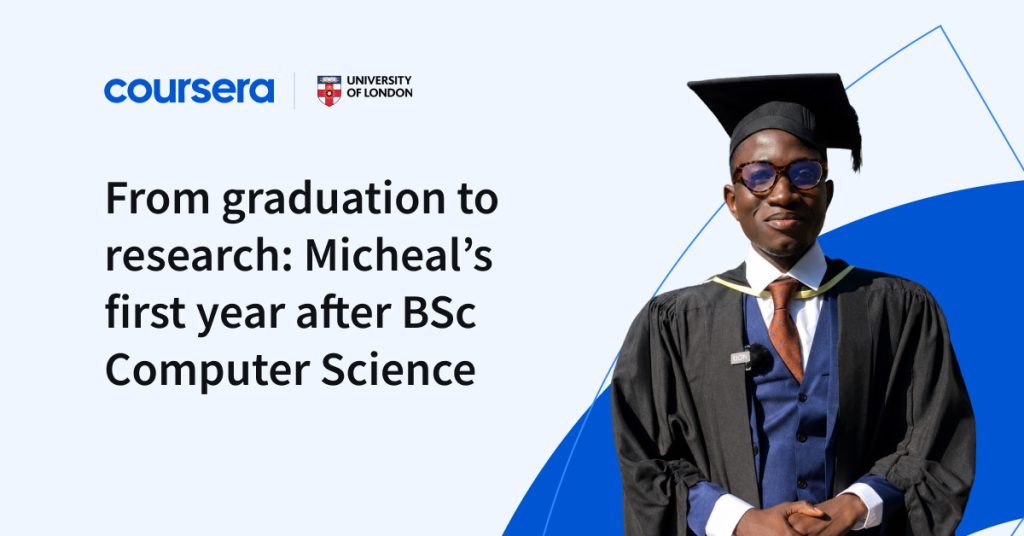
For Micheal Olawale, graduating with a BSc Computer Science from the University of London marked the beginning of a new chapter, one where he could apply what he had learned in a more independent, real world setting.
A year after crossing the stage at the Barbican Centre, Micheal is now conducting research at Swansea University. Reflecting on the transition, he describes it as both “stretching and rewarding.”“Moving into a self-driven environment made me realise how much responsibility comes with applying what you’ve learned,” he says. “At the same time, it has been fulfilling to see theory come alive.”
Building skills that translate to the real world
Now working in software verification, Micheal focuses on ensuring complex systems, such as railways, operate safely and correctly.
His day-to-day work draws directly on the foundations built during his BSc Computer Science. From algorithms and software engineering to discrete mathematics and computer science logic, the concepts he studied continue to play a central role.
“The programme gave me a strong foundation in problem solving and structured thinking,” he says. “The work I am doing now builds on the mathematics and logic I learned at the University of London.”
Learning that shapes career direction
One of the most influential moments during Micheal’s degree came through the Web Development module, taught by Professor Matthew Yee-King. Through this course, he was introduced to test-driven development, an approach that emphasises writing tests before building software.
“It made me think about building software that can be trusted, not just software that works,” he explains.
This experience helped shape his interest in software quality assurance and led him towards working on safety critical systems, where reliability is essential.
Support beyond the classroom
Alongside academic learning, Micheal made use of the University of London Careers Service to explore his next steps.
During his final year, he engaged with micro-modules and opportunities shared through the service, helping him gain clarity on his future direction.
“I would encourage all students to make use of it,” he says. “It helped me find direction.”
Developing a mindset for lifelong learning
Beyond technical knowledge, Micheal highlights the lasting impact of the programme on how he approaches learning and problem solving.
“I have become more curious, more intentional, and more structured in how I think,” he reflects.
In a fast-moving field like computer science, this mindset has been key to staying motivated and continuing to grow.
Advice for future students
For those considering or currently studying the BSc Computer Science, Micheal emphasises the importance of building real understanding.
“Focus on truly understanding what you are doing,” he says. “Take time to explore beyond the curriculum, build projects, and challenge yourself.”
For graduates, his advice is to stay open and adaptable. “You do not need to have everything figured out. Stay consistent, keep learning, and have faith.”
Explore the BSc Computer Science at the University of London and build in-demand tech skills.