
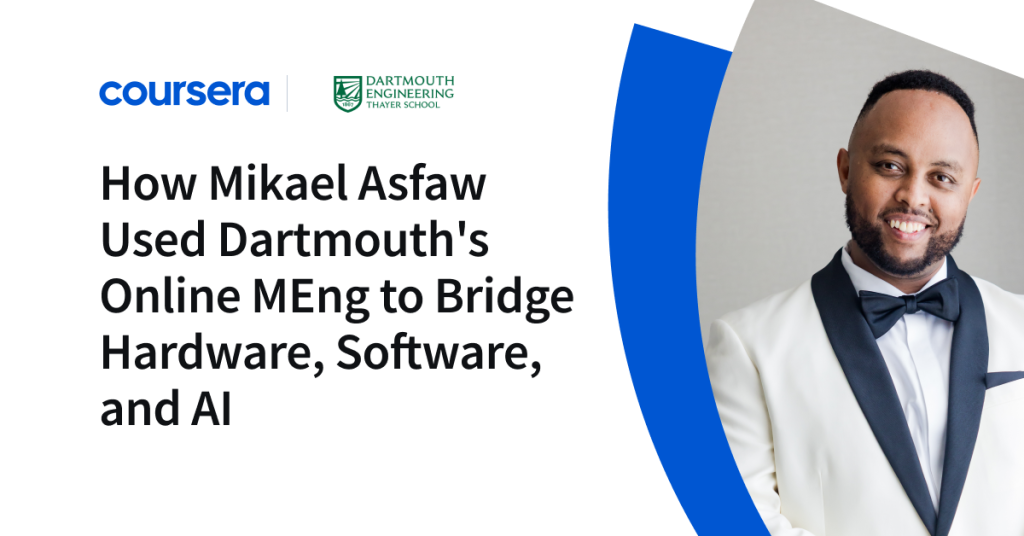
After more than a decade building cutting-edge technology at companies including Apple, Google, Meta, Tesla, and Waymo, Mikael Asfaw was ready for his next challenge.
A Principal and Staff-level Embedded Audio & Acoustics Engineer with more than 10 years of experience and 18+ patents, Mikael had built a successful career in hardware engineering. But he wanted to deepen his software expertise, strengthen his understanding of AI, and prepare for the future of robotics.
That search led him to Dartmouth’s Master of Engineering in Computer Engineering (MEng).
Finding the right program
Mikael was already familiar with Coursera before he began exploring graduate degree options. He first discovered the platform through Andrew Ng’s Machine Learning course and came to see Coursera as a place where learners could access instruction from faculty at leading universities.
When he started researching online master’s programs, Dartmouth’s Master of Engineering in Computer Engineering immediately stood out. The curriculum aligned closely with his goal of expanding beyond hardware engineering into embedded systems, AI, and software development.
“It looked well curated and exactly what I needed to advance my skills and career,” he says.
What appealed to him most was the program’s ability to bridge hardware and software. Rather than teaching them as separate disciplines, the Dartmouth curriculum takes a project-based approach, challenging students to build complete, intelligent systems from the ground up.
This systems-oriented approach gave Mikael a deeper understanding of how software controls hardware in real-world applications, which was critical for Mikael’s long-term goals in AI and robotics.
“This degree is the perfect middle ground between software and hardware,” Mikael says. “It will allow me to create my own systems and solutions that will drive the future of hardware, AI, and robotics.”
Balancing work, life, and graduate school
Like many learners in Dartmouth’s online MEng program, Mikael has pursued his graduate degree while working full time. Balancing 15–20 hours of coursework each week alongside professional and personal responsibilities has been demanding, but the program’s flexibility has made it manageable.
“It is at times challenging to juggle a full-time job, personal responsibilities, and an engineering master’s program,” he says. “But Dartmouth allows some flexibility when there is a schedule challenge, and the program management is very understanding that most of the cohort are working professionals.”
Beyond the program’s flexibility, Mikael has benefited from its collaborative, project-based approach. Working on team projects with peers from around the world has exposed him to diverse perspectives while reflecting the distributed nature of today’s engineering teams.
Combined with twice-weekly optional live sessions led by Dartmouth’s award-winning faculty and teaching assistants (TAs), the program has given him opportunities to apply what he’s learning while receiving regular feedback and support.
Turning learning into career growth
As Mikael progressed through the program, he began seeing the impact of what he was learning almost immediately.
“Halfway through the program, I have successfully transitioned from a standard hardware engineer to an Embedded Software Engineer.”
For someone who enrolled with the goal of strengthening his software and AI capabilities, that transition marked an important milestone. It reflected how quickly he was able to apply what he was learning to his work, particularly in robotics and embedded systems.
“The knowledge and skills I obtained from this program are allowing me to solve current and future problems as I develop proprietary hardware and autonomous systems.”
Looking ahead, Mikael sees the degree as more than a credential. Through rigorous coursework and hands-on projects using hardware kits shipped directly to his home, he has gained the technical skills and confidence to tackle increasingly complex engineering challenges.
For Mikael, the investment has already paid off, not only in a successful transition into embedded software engineering, but also in the confidence to pursue what’s next. As technology continues to evolve across AI, robotics, and intelligent systems, he is building the skills needed to help shape that future.
Ready to advance your engineering career and lead innovation in your field? Learn more about the Dartmouth Master of Engineering in Computer Engineering.