
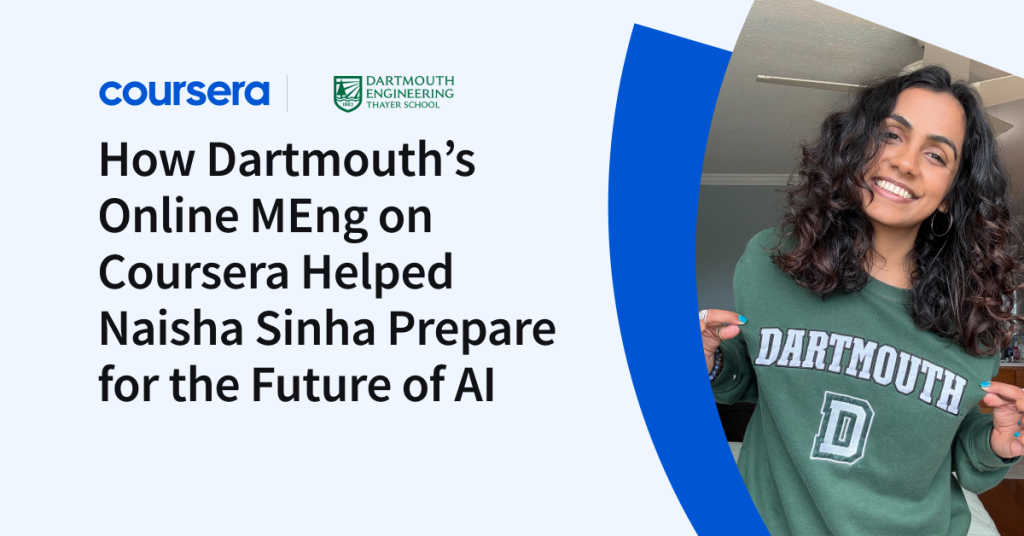
For ambitious professionals like Naisha Sinha, staying ahead of the curve in artificial intelligence is essential. While working full-time as a Hardware Verification and Support Application Engineer at Siemens, Naisha sought to deepen her expertise without pausing her career.
She found the perfect solution in the online Master of Engineering in Computer Engineering from Dartmouth College, offered on Coursera. Her story is a powerful testament to how flexible, high-quality online learning can bridge the gap between ambition and achievement.
Choosing a path to an AI-powered future
Already familiar with Coursera’s structured learning format, Naisha sought a master’s program that offered both flexibility and academic prestige. The Dartmouth MEng on Coursera was a perfect fit.
The opportunity to learn from a world-renowned institution was a major draw. “Being able to learn about AI from professors at such a reputable institution (especially one where the term AI was originally coined!) while continuing to work full-time was an incredible opportunity,” Naisha says.
She knew that courses such as Natural Language Processing, Machine Vision, and Advanced FPGA Design would provide the cutting-edge skills she needed. “Looking over the courses offered… I knew the program would help me develop skills and knowledge to handle all the new emerging technologies,” she adds. As she learned more, her confidence grew that the program would position her for long-term success.
Balancing ambition with a full-time career
Many working professionals worry about balancing a degree with a career, but Naisha met the challenge head-on, completing the program in under two years while working full-time and even serving as a Teaching Assistant for the Natural Language Processing course.
She admits it was demanding, but the program’s design made it achievable. “There were definitely late nights (as anyone pursuing a degree can relate to),” she shares, “but the program’s structure and faculty support made it manageable.”
A key to her success was the program’s thoughtful organization. The asynchronous format provided flexibility, while a consistent weekly structure with coursework released and due at the same time each week created a predictable rhythm.
This was enhanced by robust, optional support systems. “Regularly [optional] scheduled office hours from both TAs and professors,” she adds, made it “easy to get help before assignments were due.” Beyond scheduled help, the faculty created a nurturing environment. As Naisha puts it, “The faculty were also incredibly supportive and understanding.” This combination of structure and support allowed her to build a sustainable routine.
Building skills, confidence, and community
The impact of the Dartmouth MEng program extended far beyond the diploma. The hands-on curriculum that allows students to work on actual hardware shipped to them by Dartmouth, gave her tangible engineering and AI skills and a significant confidence boost.
“I feel much more confident working with both new hardware and software tools related to AI,” she says. “The project-based curriculum allowed me to actively apply what I learned… and develop the ability to clearly explain and present complex concepts – skills that have been incredibly valuable in my career.”
Beyond technical growth, Naisha discovered a vibrant community. “Completing the program through Coursera allowed me to connect with a diverse group of peers who were also working full-time across different industries, and even different countries!” she says. This global network provided shared motivation and a strong sense of belonging.
Thanks to the structure of the courses with team projects, active Slack communications, live (optional) office hours, as well as the size of the program, Naisha was able to keep in contact with peers throughout various terms and courses and continues to deepen those connections.
As Naisha says, “Despite being fully online, the program made it easy to feel like part of the broader Dartmouth community.” This feeling was solidified by her inclusion in Dartmouth’s extensive alumni network, which connects her with both online and on-campus graduates.
Advice for future learners
For those considering a similar path, Naisha emphasizes leveraging the program’s built-in support systems. “The biggest factors in my success… were the faculty, the routines I developed, and the resources provided,” she advises.
She highlights the collaborative community developed through platforms like Slack, where students post about “new technologies, upcoming conferences, and important reminders.” She notes, “That sense of community created a shared motivation that played a major role in my success.”
She also praises the curriculum design, which encouraged students to think independently and solve problems, a balance that helped reinforce her learning, build confidence, and deepen her understanding of the material.
Naisha’s journey illustrates that a top-tier education from an institution like Dartmouth is within reach for dedicated professionals everywhere. Her story is not just about earning a degree, it’s about gaining the confidence, network, and hands-on skills to become a leader in the age of AI.
By embracing flexible online learning that Coursera offers in partnership with Dartmouth College, she transformed her career and gained the confidence to continue pursuing new opportunities in the evolving field of AI.
Explore the Master of Engineering in Computer Engineering from Dartmouth College to gain in-demand skills in AI and engineering.