
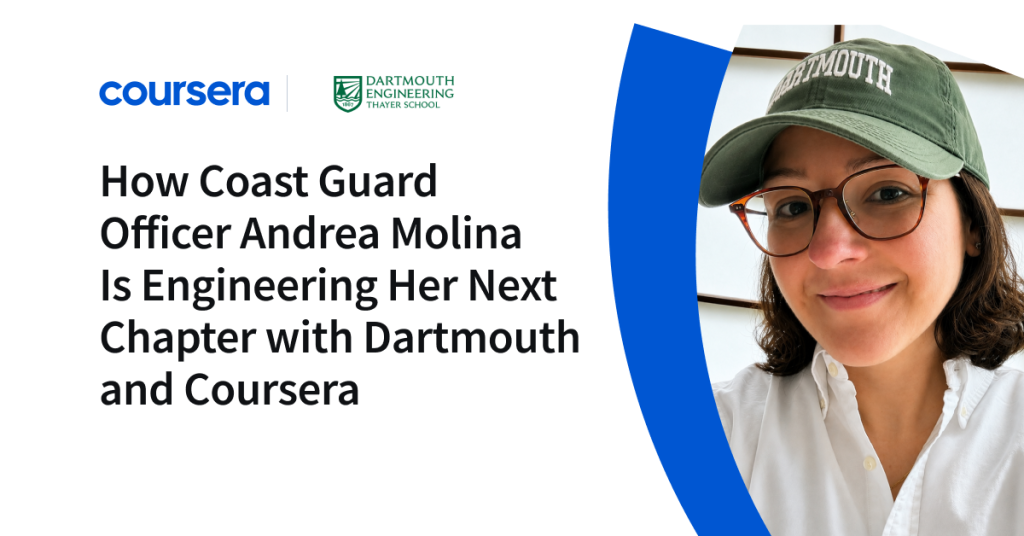
Andrea Molina has spent her career working at the intersection of technology, leadership, and service. As an active-duty Coast Guard officer, she directs Command & Control and Navigation requirements across air, sea, and land domains. Outside of her service, she teaches graduate courses at Johns Hopkins and advises doctoral candidates at George Washington University.
But even with an advanced technical career and a Doctor of Engineering in Cyber Analytics, Andrea wanted to get closer to the engineering itself. She wanted to understand machine learning from the ground up, work directly with hardware, and develop the skills to build, not only direct, complex technical systems.
Dartmouth’s online Master of Engineering in Computer Engineering, offered in partnership with Coursera, became the next step.
Staying in uniform while going deeper into engineering
For Andrea, pursuing that next step came with one non-negotiable: she needed to continue serving.
“Coursera let me stay in uniform while I pursued this. I’m an active-duty Coast Guard officer, and I didn’t have the option to pause my career for a traditional on-campus program. Dartmouth’s name and rigor mattered to me, but it was the online, self-paced structure through Coursera that actually made it possible to enroll in an Ivy League engineering program during my final stretch of service.”
Just as important was what Andrea could learn. Dartmouth’s MEng brings together computer engineering and computer science, giving her the opportunity to go deeper into machine learning while applying that knowledge through embedded systems and hands-on engineering work.
“What I wanted next was to understand what’s happening underneath those libraries: to build the models from scratch, and then take that understanding into hardware. Dartmouth’s M.Eng. in Computer Engineering was the rare program that let me do both – real machine learning and real embedded systems work — at the depth I needed.”
That combination has taken Andrea from hand-deriving gradient descent and building a multinomial classifier from probability theory to working directly with microcontrollers, accelerometers, fixed-point DSP filters, and Bluetooth-connected sensor data.
“That’s the moment the degree clicked for me — watching a signal go from a physical sensor, through math I wrote myself, out over the air. That’s the “physical AI” space I came here for.”
Navigating a degree alongside a demanding mission
With Andrea’s professional and academic responsibilities, progress often happens in small windows rather than long stretches of uninterrupted study.
“Honestly, it hasn’t been a graceful balance so much as a constant renegotiation. I lean hard into small blocks of time: labs get worked in the evening, in pieces, one section at a time.”
Andrea also treats the mistakes as part of the learning. Instead of simply completing an assignment, she documents her reasoning, failures, and reflections so she understands not only what worked, but why.
“That habit of narrating my own thinking, rather than just producing an answer, is what’s made the material stick and made the mistakes worth something.”
Charting a course for what comes next
The impact of Andrea’s coursework already extends beyond the program. She brings what she learns into her teaching and into how she advises doctoral students working in applied AI/ML and cyber analytics.
Soon, those skills will take on another purpose.
“I’m retiring from the Coast Guard soon, and this program is the bridge from a career built on directing and governing technical programs into one where I can build and lead at the engineering level itself.”
Andrea’s next chapter isn’t about starting over. It’s about building on a career of technical leadership with deeper engineering expertise. By combining Dartmouth’s rigorous approach to computer engineering with hands-on learning across machine learning and embedded systems, all in an online format she can pursue through Coursera, Andrea is preparing to carry her experience from one mission into the next.
Explore the Master of Engineering in Computer Engineering from Dartmouth College to build hands-on skills in machine learning, embedded systems, and engineering.