
Last week, we held our first internal hackathon at Coursera. What’s a “hackathon”? Well, it can take many forms, but it’s basically when a bunch of software engineers get together and hack on a particular project during a condensed period of time. Of course, we software engineers are always hacking on something, but we’re usually working on incremental updates to existing features or bug fixes, whatever is the highest priority project at the moment. During a hackathon, we get the opportunity to put all our main projects on the backburner for a few days, and work on something completely new and different. It’s a chance to try out ideas we’ve had milling at the back of our heads, to learn new technologies, and to work with colleagues outside our usual team.
So, on Thursday at noon, we kickstarted our first hackathon with a round of pitches. We gave everyone exactly one minute to explain what they wanted to work on and why other people should join them. We heard pitches from everyone in the company – designers, course ops, business development, and even recruiting. Then teams formed, and the brainstorming began. Our whiteboards were soon covered with website layouts, database schema diagrams, RESTful API schemes, and lists of who would do what. We wanted to give everyone enough time to actually get some code written and sleep (which is admittedly not often a component of hackathons, but we’re all about sustainability at Coursera), so we gave the teams all of Friday complete their hacks.
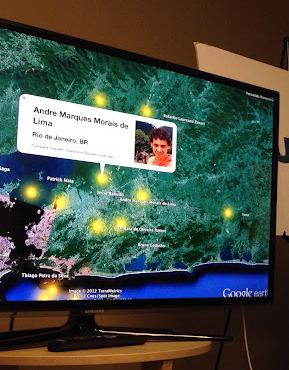
At 5pm on Friday, conveniently timed to coincide with our weekly happy hour, the teams demo’d their hacks to rest of the company. The first team ushered all of us into our front lobby, to show off the TV that they’d installed and hooked up to an interactive stats display. We all “ooh”ed and “ahh”ed as we watched a 3d Google Earth spin round and zoom into the locations of our users and then zoom out to show the glow of realtime visitors around the globe.

The rest of the hacks were equally impressive, and hopefully, aspects of them will make it into your own Coursera experience soon. Our celebrity judge (also known as our amazing office manager, Julia Alperovich) awarded a much-coveted remote control tarantula to the “hack that did the most for our students”, and thus concluded our first hackathon. Until next time!
– Pamela Fox, Frontend Engineer