Coursera
  • Find a Course
  • Sign Up
Coursera Blog
  • Degrees
  • For Business
  • For Educators
  • Product News
  • Stories

Launching SkillSets for Coursera for Campus: Preparing Students for High-Growth Entry-level Jobs

By Shwetabh Mittal, Senior Director, Product Management

University students are graduating into a new labor market, changed drastically by automation and the pandemic. The World Economic Forum estimates 85 million jobs will be displaced globally by 2025, with 40% of core skills changing for jobs that are set to remain.

The shifting skills landscape is also creating opportunities in the workforce, with 149 million new digital jobs expected by 2025. However, companies feel there is a mismatch between the skills students are graduating with and the skills required in the modern workplace. Recent research by Burning Glass Technologies found that hiring for entry-level college graduate positions has fallen 45%. 

Skills can connect academic curricula and the needs of employers. Today, we’re excited to announce that after a successful pilot, SkillSets are now available to any university using Coursera for Campus, an innovation that enables higher education institutions to prepare their students for high-demand jobs at scale. Students choose their target entry-level job, and SkillSets determine the exact skills they need to land those jobs and the content that will help prepare them. 

SkillSets are job-based learning programs that help universities: 

  • Drive target skill proficiencies needed for specific high-demand jobs for students at scale, with world-class content from leading university and industry educators like Johns Hopkins University, University of Michigan, Google, and IBM 
  • Accelerate skills acquisition through dynamic, personalized learning experiences for each student that curates content based on current skill level and target proficiency 
  • Integrate hands-on learning with Guided Projects to drive mastery of digital tools like Google Ads, WordPress, and Excel, and create portfolios of work 
  • Track skills development and proficiency at the student and cohort level, benchmarked against real employees in the industry 

Employers and students are increasingly looking to universities to prepare graduates for a competitive and fast-changing workforce. Universities are responding to the new paradigm, evolving their approach to deliver strong student outcomes by providing skills-first employability curricula.    
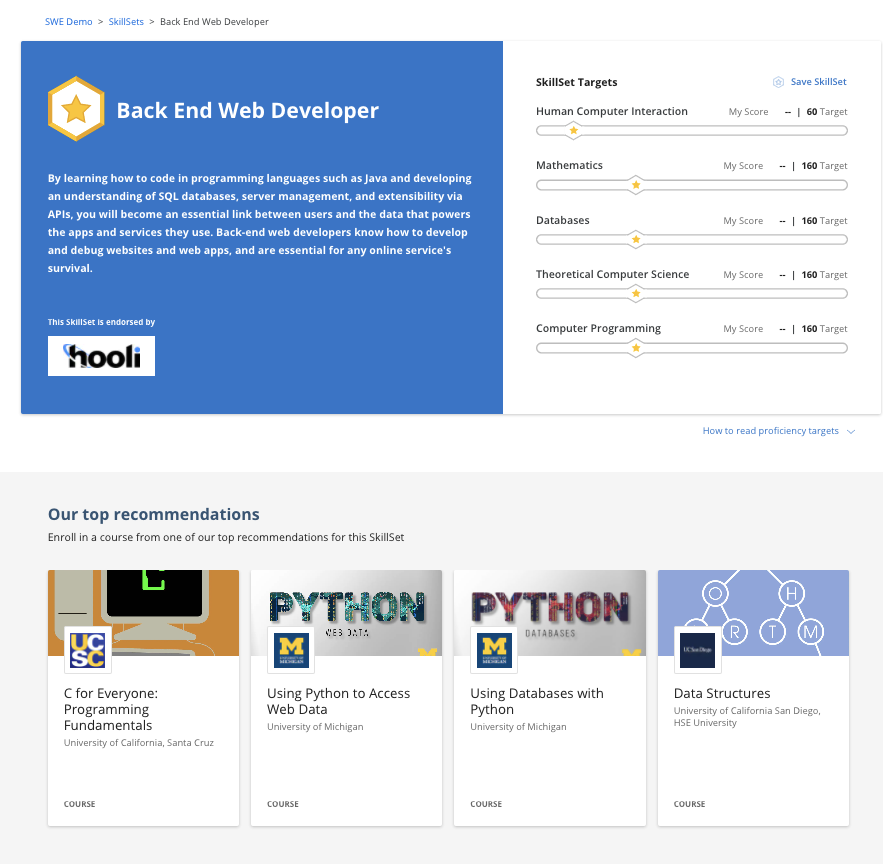
Within SkillSets, a given skill is assigned a target score between 0 (a true beginner) and 500 (the highest level of proficiency and mastery). 
Learners are then presented with a set of dynamic, data-driven course recommendations that tie to their skill goals. When a learner successfully completes a course assessment, the corresponding skill score increases.

With SkillSets, students can gain both the theoretical and applied knowledge they need to secure their chosen job upon graduation, and they can track their progress against their goals. Skills development analytics are important because universities need to know not only the skills required for specific jobs, but be able to communicate the level of skill proficiency their students can bring to that role. This creates the opportunity to connect skills-first learning with skills-first hiring. 

By developing the language of industry, universities can build relationships with recruiters and employers and match candidates to the right opportunities based on their skills. 

PROFICIENCY BY SKILL

PROFICIENCY BY SKILL INDUSTRY BENCHMARK
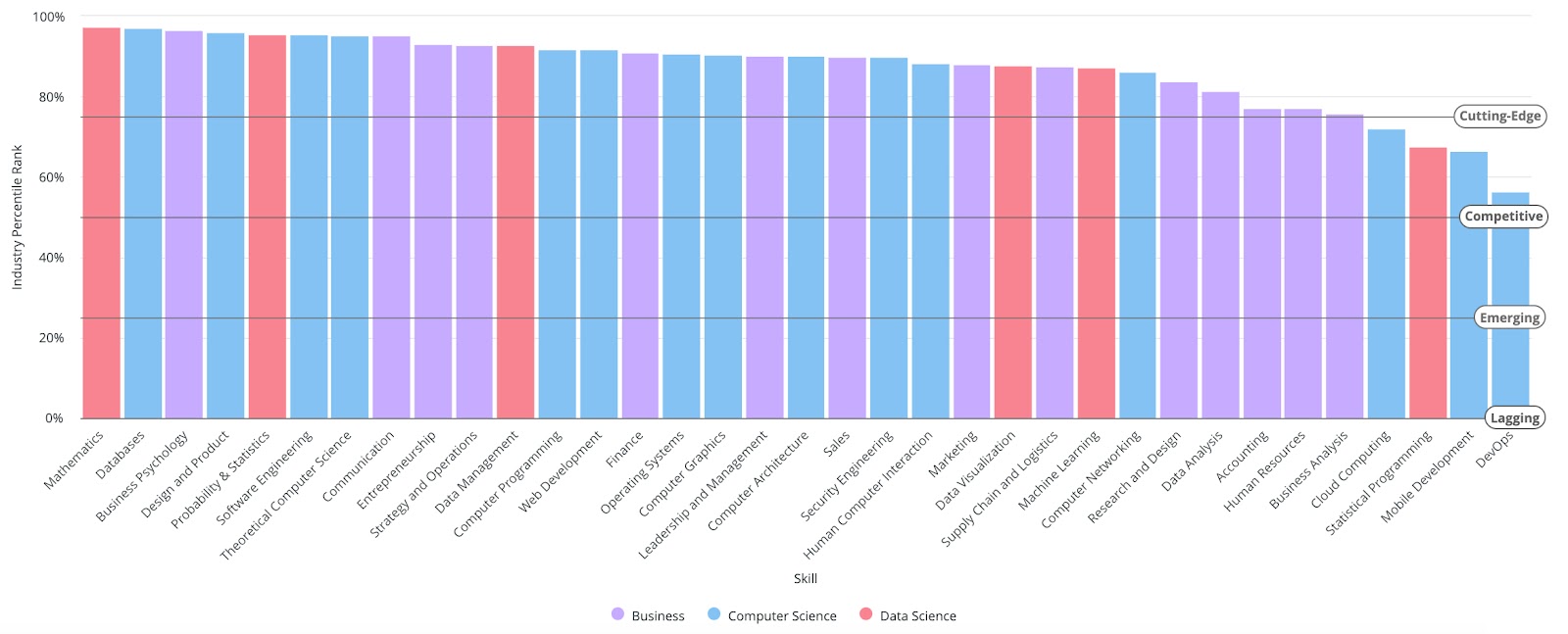
Measure the impact of SkillSets through the Skills Development Dashboard. 

With SkillSets, employers can hire with more confidence that university students are graduating with the same skills as current industry professionals. Collaboration between universities and employers will help prepare graduates for the new digital economy. To learn more about how you can use SkillSets to unlock employment opportunities for your students, visit coursera.org/campus.

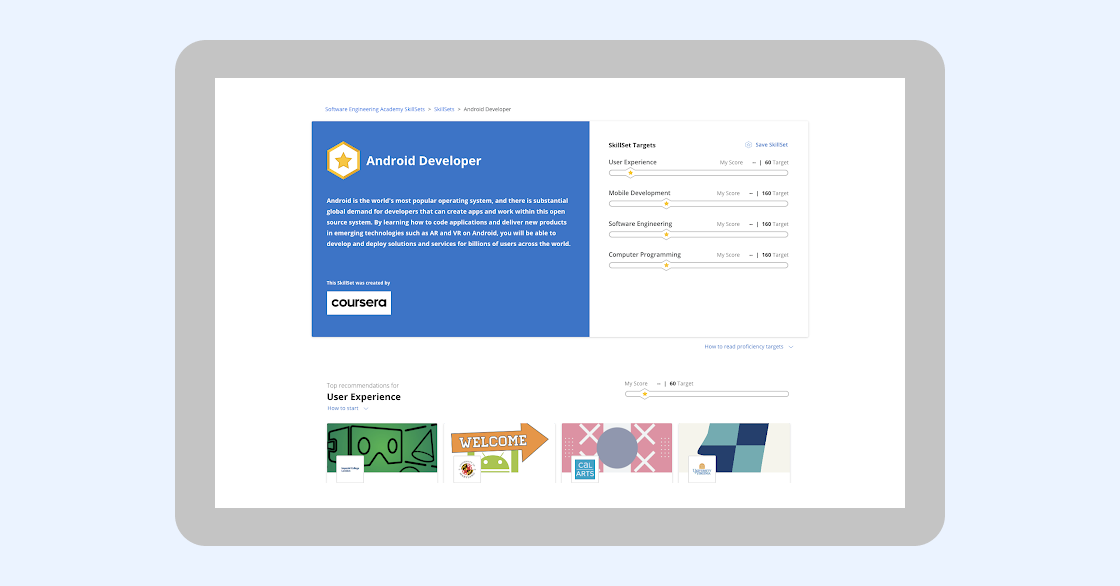
Deliver job-based learning and build a cutting-edge curriculum

By Shwetabh Mittal, Senior Director, Product Management

We’re excited to share details with you about some exciting new Q3 launches. In this post, we’ll specifically be discussing SkillSets, which are job-based learning programs that can help you bridge skills gaps and boost student job outcomes as well as new curriculum integration features—including curriculum recommendations, for-credit tagging, limited availability schedules, and the online gradebook.

SkillSets

SkillSets are job-based learning programs that leverage world-class courses from leading universities and companies, hands-on learning, and skills insights derived from Coursera learners at over 2,300 employers. With dozens of SkillSets currently available, you can confidently prepare students with the in-demand skills necessary to secure today’s high-growth jobs. Within a given SkillSet, students will take courses and projects tailored to their existing proficiency levels that accelerate their skill mastery.

Example SkillSet

What are the benefits of SkillSets?

SkillSets will enable you to confidently deploy tailored, job-based learning programs at scale. SkillSets leverage Coursera’s comprehensive skills and role insights to identify the high-growth jobs that companies are hiring for, and the corresponding skills they require. This allows you to:

  • Choose from dozens of job-based learning programs that develop in-demand skills for entry-level roles.
  • Deliver job-based learning with confidence, knowing that you’re teaching exactly the in-demand skills necessary to drive stronger student employability outcomes.
  • Deliver tailored learning experiences with dynamic course and project recommendations that are optimized for the proficiency level of each student.
  • Drive mastery of in-demand tools and technologies using Guided Projects that leverage a side-by-side interface in a virtual cloud workspace. 

Additionally, with our Skills Development Dashboards, you can track student progress and monitor skill acquisition over time. Also, you can compare student skills against industry benchmarks. In addition to optimizing your learning programs, this information will allow you to share actionable insights with prospective employers and match candidates to the right opportunities based on their skills.

Learn more about SkillSets in our announcement here.

Curriculum Integration 

Successful curriculum integration begins with easy and effective navigation—the ability to quickly find the right courses to supplement your curriculum and fit your students’ needs. Then, you’ll want to seamlessly incorporate that content into your learning programs and workflows. And finally, you need to be able to deploy courses and monitor student progress. To achieve all these goals, we’re introducing some great new features. Let’s review each one:

Curriculum recommendations. Our curriculum recommendations feature will help you navigate the Coursera catalog to select the courses that supplement your curriculum and fit your students’ needs. This feature allows you to:

  • Browse courses by academic discipline making it easy for you to discover the courses in our catalog that correspond with the core subjects you are teaching in your curriculum.
  • View our recommendations of courses to offer for credit based on our extensive skills expertise and data to leverage the courses in our catalog that are most suitable for your core curriculum. 

For-Credit Tagging: In addition to the enhanced navigation functionality described above, this feature allows you to choose and tag which courses you would like to offer for credit. This makes it easier for your learners to see which courses are part of your core curriculum that they need to complete, right from within the Coursera platform.  

Limited Availability Schedules: You can use this feature to offer courses within timeframes that align with your academic term or other timelines that your institution observes. This simplifies program management, as you don’t have to worry about multiple, misaligned timelines. For your students, this will help to ensure they’re progressing as a cohort in order to comply with the timelines you have set. 

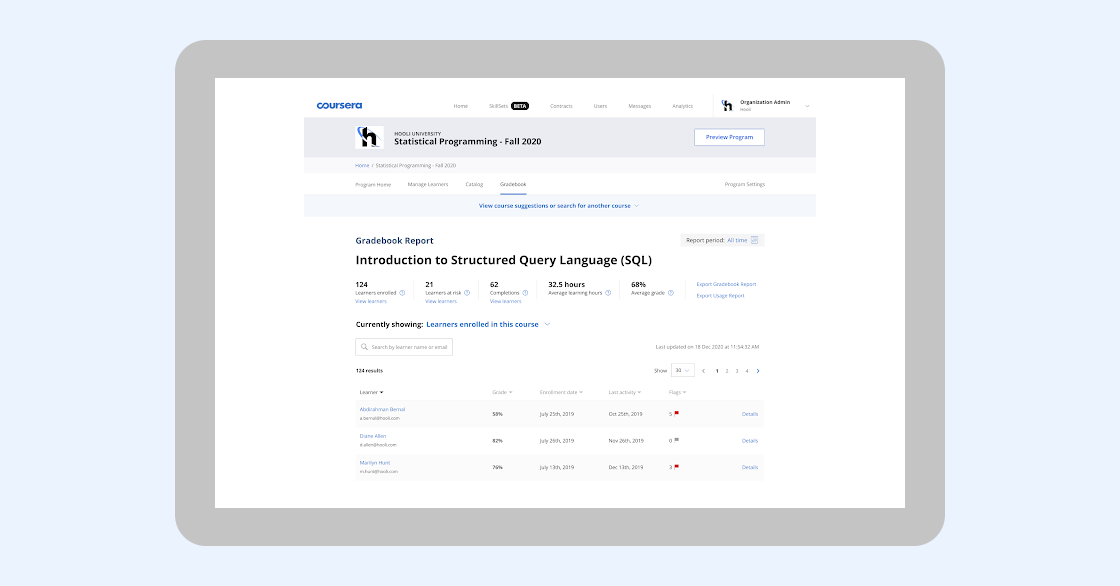
Online Gradebook: Our online gradebook provides you with course progress monitoring abilities, right from within the Coursera platform. Leveraging this functionality, you will be able to:

  • Track the progress of students taking a course across in order to ensure that your students are moving smoothly throughout the course. You can see this progress at a cohort level for the current academic term or for all students who have taken that course. 
  • Identify learners who are enrolled, at risk, inactive, or who have completed the course in order to take necessary corrective measures. 
  • Export data to load into your LMS in order to analyze this information along with the rest of your program information. 

The online gradebook also provides information at an individual level, allowing you to see how a student is progressing in a course, how they have performed in assignments and quizzes, and where their progress has stalled. Additionally, if you see anything that is a cause for concern (e.g. a student has failed a quiz or has been inactive), you can send them a message from within the online gradebook, providing that proactive nudge they might need. 

Online Gradebook

We’re excited for you to start taking advantage of these new features. If you have any questions or comments, please reach out to us or contact your customer success manager.

Prepare for Career Success in the New Global Economy

by Ekaterina Zinkovskaya, eLearning Office, HSE University 

Earn a master’s degree from HSE University in key career fields like data science, business analytics, computer vision, and more.

As the employment landscape continues to rapidly evolve in response to unprecedented technological, economic, and environmental disruptions across the globe, universities are playing a critical role in adapting their programs to help ensure that students are learning the most in-demand skills and are well prepared to succeed in their careers.

HSE University’s master’s programs on Coursera offer students the opportunity to gain the skills and knowledge necessary to succeed in today’s new labor market. The World Economic Forum, in their Future of Jobs Report, has identified key professional areas to focus on: data analysis and artificial intelligence, engineering and cloud technology, product development, sales, marketing, and content management, as well as the care economy, green economy and culture. Together, these spheres are predicted to provide 6.1 million jobs in the next few years.  

Our programs are tailored to meet the needs of learners pursuing career advancement in these growing fields, and we emphasize real-world skills mastered through on-the-job learning cases. As a result, HSE University graduates enter the labor market with high levels of career confidence. According to the HSE University Centre for Institutional Research, 83% of graduates feel competitive in the labor market. That same percentage of respondents also report employment in their specialty, and the employment rate of those surveyed at the time of graduation is 96%. 

Below we explore master’s programs in data science, computer vision, finance, business analytics, and data and network analytics. We discuss topics covered in the programs, as well as career paths and salary expectations for each of these fields.

The Master of Data Science program, the first of its kind to be offered by a Russian university on Coursera, is designed for students pursuing successful careers in data analysis, machine learning development, and research. With learners coming from more than 30 countries, including Russia, India, the United States, China, Germany, the UK, and more, the program is truly global. In addition to being qualified for postgraduate research in data science, graduates are also prepared for data scientist and machine learning engineer positions. In Russia, applicants with one year of experience earn a monthly income of 115 thousand roubles, while experts with six years of experience start at 300 thousand roubles a month. In the US, the income of a novice data scientist is $68,000 a year. 

The Master of Computer Vision program provides students with the opportunity to gain the knowledge and tools necessary for careers in computer vision software engineering, perception engineering, 3D perception/computer vision algorithm engineering, computer vision test engineering, and computer vision science. The program is developed by experts from the Faculty of Informatics, Mathematics, and Computer Science, as well as experts from industry leaders such as Huawei, Itseez3D, Intel, Harman, and Xperience.ai. Qualified practitioners are in high demand accordingly and typically command high salaries. In London, computer vision specialists earn over £76,000 a year on average. In New York, that figure is over $160,000, and in San Francisco, it’s over $170,000 a year. The Master of Computer Vision program is ideal for practicing engineers, programmers, IT specialists, developers, and AI experts who are ready to grow their careers, as well as mid-career professionals looking to change their career tracks and young professionals with IT and math backgrounds who are eager to launch their careers in this emerging field.

The Master of Finance master’s program was established at the HSE Banking Institute based on the CFA (Chartered Financial Analyst) Institute syllabus. The program is tailored to benefit recent graduates and aspiring professionals who want to take up leading positions in finance: practicing consultants and financiers; specialists in financial reporting and analysis; economists, managers, and lawyers working in related fields; strategic managers who evaluate investment decisions; owners and founders of start-ups, and more. Program graduates are prepared for careers at Russian and international banks, investment funds, rating agencies, consulting groups, auditing companies, and government financial institutions. In Russia, financial analysts currently earn a monthly salary starting at RUB 150,000, while a director of finance and investments can earn at least RUB 200,000 a month. In the US, the average yearly salary of a financial analyst starts at $61,000 per year.  

Students in the Master of Business Analytics program of the Faculty of Economic Sciences at HSE University build knowledge and skills to succeed in finance, accounting, and compliance careers. The program curriculum covers current processes in corporate finance and business decision-making; valuation and management of company value with regard to the contribution of non-financial capitals; value-oriented compliance methods; business risk management methodology based on the integration of non-financial capitals; and new standards of strategic reporting by companies, based on very new initiatives of value reporting by regulatory bodies. The program is ideal for those just beginning their careers as well as mid-career professionals looking to move into a new career track. Within the Russian labor market, a senior business analyst at an IT company receives a monthly salary starting at 170,000 roubles. An analyst in an investment bank and a compliance consultant will typically begin at 200,000 roubles. On the international market, a senior business analyst at an IT company can earn a salary starting at $8,000 per month, and a chief compliance officer can generally expect to start at around $16,500 per month.

The Master of Data and Network Analytics program was developed by experts from the International Laboratory for Applied Network Research at HSE University. In response to the prevailing shortage of qualified data analysis experts across the globe, the program is specifically geared towards helping students master the essential skills necessary to fill these in-demand roles. The curriculum includes comprehensive training in the latest state-of-the-art analytics. Graduates of the program will be prepared to succeed in fields such as economics and finance, management, public administration, IT, medicine, and research. Data analysts with the kinds of diverse skills learned in this program are highly valued across industries and generally earn high salaries. For example, a data analyst in Moscow with 3 to 6 years of experience can earn between 200,000 and 350,000 roubles a month. The average salary for a Data Analyst in the US is $73,000 a year, while Lead Network Engineers earn around $120,000 a year. 

As the modern global economy continues to evolve, HSE offers a wide range of opportunities for you to build valuable career skills that are in high demand across growing industries. Whether your focus is on established areas such as finance or emerging fields like computer vision, you’ll learn from leading scholars and top industry experts as you gain the skills and knowledge to succeed in your chosen career field.

Coursera for Business Launches Leadership Academy to Deliver World-Class Management Training at Scale

By Leah Belsky, Coursera Chief Enterprise Officer

The disruption and uncertainty caused by digital transformation, and widespread adoption of hybrid work have created new challenges for organizations. These challenges require leaders to keep pace as change accelerates.

Today, we’re excited to launch the Leadership Academy to help companies develop the next generation of leaders and high-performance teams amid a rapidly changing workplace, remote work, and back-to-office transitions. 

Offered as part of the company’s enterprise platform Coursera for Business, the academy will feature content from the world’s top universities and companies — taught by many leading instructors. Coursera’s growing portfolio of Academies includes the Data and Analytics Academy, Cloud and IT Academy, Software Engineering Academy, Marketing Academy, Finance Academy, and now Leadership Academy. Coursera’s six academies are powered by our proprietary and innovative SkillSets platform, which helps employees develop specific skills for specific roles. 

The Leadership Academy features 42 SkillSets, including Emotional Intelligence, Interpersonal Skills, Change Management, and Organizational Development. These cutting-edge SkillSets make leadership skills measurable, enabling employees and managers to track progress against skill development targets as learning progresses.

 The Leadership Academy prepares employees for a range of different leadership roles by learning to:

  • Lead Yourself – enable employees to develop leadership behaviors by obtaining a foundational understanding of management, change, and human skills.
  • Lead Teams – develop team leadership capabilities by strengthening change, recognition, people development, and collaboration skills.
  • Lead Organizations – build organizational leadership capabilities that empower leaders to grow people and profits.
  • Lead Transformation – develop workforce capabilities that empower all employees to adapt, innovate, and transform the business.

The Leadership Academy features over 350 job-based content recommendations from leading university and industry partners including:

  • High Performance Collaboration – Leadership, Teamwork, and Negotiation by Professor Leigh Thompson from the Kellogg School of Management, Northwestern
  • Communications Strategies for a Virtual Age by Ivan Wanis Ruiz from the University of Toronto
  • How to Manage a Remote Team by Darren Murph and Jessica Reeder from GitLab Inc.
  • High Stakes Leadership: Leading in Times of Crisis  by Professor Mike Barger from the Stephen M. Ross School of Business, University of Michigan 

Enterprise cloud data management company Informatica is among the first to embrace the Leadership Academy. 

“The notion that great leaders are born, not made, is misleading. An important part of leadership development is the realization that there are component skills that can be learned and mastered,” said Matt Dearmon, Director of Leadership and Professional Development at Informatica. “As the world keeps changing, we need to support leaders at every level of our organizations with the types of targeted, reliable skills that form the basis of the Leadership Academy. We’re excited to leverage this Academy to help deliver skills-focused leadership training that is both scalable and personalized to the needs of the learner. We can meet them where they are and help take them where they want to be.”

Starting today, the Leadership Academy will become broadly available to all Coursera for Business customers. With the Leadership Academy, we look forward to helping customers provide teams across their organization with job-based skills development paths, and to equip them with the growth mindset and human skills required to thrive in a digital economy. 
For more information about Coursera Academies, visit: www.coursera.org/business/leadership-academy.

Go to Coursera for Business

Introducing Six Curriculum Maps for Student Employability

A new economic infrastructure, built through innovations such as cloud computing, big data, and artificial intelligence, is propelling work into the “next normal.” In this digital era, career success will depend on the ability to continuously adapt alongside technology. This affects not just the way we work, but fundamentally, the skills we learn. As the institutional bridge between education and work, universities must increasingly ensure that students are equipped with job skills necessary to thrive in this digital world.

These are important topics for university leaders to consider as they prepare students for the workforce:

  • How can higher-educational institutions embrace digital capabilities to keep pace with the accelerating rate of technological change? 
  • How can educators both identify and anticipate the skills of the future? 
  • How can existing programs of study be reconfigured to ensure that students are job-ready?

Coursera’s latest e-book, Curriculum Mapping for Student Employability, addresses these questions head-on. With more than 86 million learners, 4,000 academic institutions, 300 government entities and 2,000 organizations having used the Coursera platform  (as of June 2021), Coursera is uniquely positioned to help higher education institutions align with the skill needs of the modern workforce. The curriculum maps presented in this eBook converge these rich insights with expert curations led by Coursera’s Skills Transformation team. 

The six custom curriculum maps featured in this eBook serve as a proposed guideline for universities looking to integrate online learning. Each map demonstrates how universities can leverage courses on Coursera to close present-day gaps and empower students to develop job-ready skills. 

This blended learning curriculum for computer science can help students to gain critical AI skills with online courses [blue]
This blended learning curriculum for business administration can help students to gain critical data analysis skills with online courses [blue]

Depending on their institutional priorities and policies, universities can incorporate online courses into their curricula as either for-credit offerings or multidisciplinary electives. In the coming months, Coursera will release several features to facilitate such integrations. The first of these features will recommend courses, organized by academic discipline, that universities can consider offering for credit to their students.

By enhancing their core curriculum with content on Coursera, universities can design forward-thinking learning programs effectively and at scale. The results—improved employment outcomes for graduates, deepened understanding of emerging skills among educators, and a more robust talent pipeline for employers—will benefit stakeholders within higher education and far beyond.

For more insights and all six curriculum maps, download the full report here.

Ingressive for Good and Coursera prepare African youth for tech careers

Partnership provides scholarships for 5,000 African youth, helps more than 100 land careers in tech

When Ingressive for Good (I4G), a tech nonprofit, began its mission to create and increase the earning power of tech talent in Africa, it was clear about the obstacles. Young people in Africa make up a significant portion of the unemployed population. Internet access across the continent can be inconsistent, and many young people don’t have access to the tools and systems they need to prepare for tech careers. Starting a non-profit under normal circumstances is difficult enough, but I4G launched in summer 2020, during the peak of COVID-19. 

I4G’s mission to train more than 1 million youths and connect 5,000 with jobs was more critical than ever. As companies with more traditional, in-person businesses started closing, increasing unemployment. I4G knew it could make a major impact by focusing on training youths for jobs in tech with higher pay rates, better job security, the ability to freelance, and remote work opportunities.

“Helping young people channel their passion for tech into the right skills isn’t just about connecting one person with one opportunity at a time, it’s about investing in leaders who will shape Africa for generations,” says Sean Burrowes, Co-Founder of Ingressive for Good. “We needed a partner who could help us with the monumental task of training thousands of people at a time. Coursera offered the right depth of courses and a great enthusiasm for our mission.”

 A priceless opportunity at no cost

I4G and Coursera partnered to provide scholarships for 5,000 unemployed or displaced workers. To attract young people to the Coursera training, I4G emphasized the value the program could offer, both in terms of building skills for tech jobs and the value of professional certifications they could earn — a certification that usually cost hundreds of dollars was free through the program. I4G tapped into its community connections to publicize the scholarship while also ramping up I4G Circles, an exclusive community of university students across Africa who are passionate about tech and leveraging it to solve problems. Recruiting social and tech influencers, and developing social media campaigns, also spread the word.

Initially, I4G expected to receive around 2,500 applications — it received more than 20,000.

“When our community understood that the scholarship through Coursera was a life-changing opportunity, we were happily overwhelmed by the enthusiasm,” says Blessing Abeng, Director of Communications at Ingressive for Good. “Our outreach success has a lot to do with the relationships we’ve built in a short period, and the power of Coursera as a world-respected program.”

I4G invited applicants only from African nations, aged 18-35, and who had financial need, or wanted to upskill in a current tech job. To offer learners the most impactful courses, I4G sought insights from leaders in tech and collected data related to industry trends. Technical skills in programming, UI/UX design, data science, cybersecurity, and machine learning, as well as backend and front-end development were crucial. Employers also were looking for talent with digital marketing skills. 

“Once we identified the skills that would give our community the best advantage in the job market, we had to map those skills to a curriculum. For an organization of our size facing such a large need, that might have been impossible,” says Burrowes. “Within the comprehensive Coursera course catalog, we could select a curriculum that we knew would benefit thousands of learners.”

Building communities of excited, engaged learners

Learners flocked to popular courses like HTML, CSS, and Javascript for Web Developers; Leadership and Emotional Intelligence; Introduction to UI Design; and Programming for Everybody (Getting Started with Python).

Many learners joined study groups to help keep each other accountable. I4G partnered with Student Build, an exclusive network of Africa’s students and recent grads, to create a peer-to-peer mentoring program centered around Coursera. The mentoring groups helped to localize international examples included in Coursera content, making content relatable to learners, and also provided peer support.

“Imagine a group of 50 people taking the same course, knowing that they’re responsible to a peer mentor who represents where they want to be in their own learning and skills. That can be a more powerful motivator than any test,” says Haneefah Abdurrahman Lekki, Community Manager at Ingressive for Good. “With Coursera, we created a culture of enthusiasm about tech that people can carry into their future careers.”

Peer-to-peer support helped to drive course completions, with more than 1,000 learners completing over 2,400 courses. 

Today’s learners become tomorrow’s dynamic workforce

Helping to place young people in jobs is essential to the I4G mission. According to I4G, more than 100 learners who completed I4G’s program are now working in tech jobs. As I4G tracked people who enrolled in and completed various Coursera courses, the organization compiled a database of learners acquiring specific skill sets, like digital marketing, coding, or website development. I4G can connect these people with its recruiter partners to fill roles for those skill sets.

I4G maintains regular contact with alumni to get updates and feedback about their progress in the workforce. This network can share insights and potential opportunities within the field, deepening the resources I4G can share with others.

Among all the learners who have completed certifications and found work, there are exceptional and powerful personal stories. One learner used his Coursera coursework to land his dream job in digital marketing and product design. An aspiring university student learned to build her own website in only one week and turned her Coursera computer science course into a lifelong passion. A digital marketer parlayed his Coursera training into work for his highest-paying clients to date.

“Coursera helped us push through a profoundly difficult time to give hope and opportunity to thousands of young people in Africa,” says Burrowes. “It’s not just an online learning platform, it’s a pathway to a better, brighter future.”

To learn more about how to transform your workforce with the skills of the future, visit Coursera for Government.

« Previous Page
Next Page »
Coursera

Coursera was launched in 2012 by Andrew Ng and Daphne Koller, with a mission to provide universal access to world-class learning. It is one of the largest online learning platforms in the world, with millions of registered learners and thousands of institutional customers.

© 2025 Coursera Inc. All rights reserved.

Download on the App Store Get it on Google Play

B Corp
  • Coursera
  • About
  • What We Offer
  • Leadership
  • Careers
  • Catalog
  • Professional Certificates
  • MasterTrack™ Certificates
  • Degrees
  • For Enterprise
  • For Campus
  • For Government
  • Become a Partner
  • Coronavirus Response
  • Community
  • Learners
  • Partners
  • Developers
  • Beta Testers
  • Translators
  • Tech Blog
  • Teaching Center
  • Connect
  • Blog
  • Facebook
  • LinkedIn
  • Twitter
  • Instagram
  • More
  • Press
  • Investors
  • Terms
  • Privacy
  • Help
  • Accessibility
  • Contact
  • Articles
  • Directory
  • Affiliates