Coursera
  • Find a Course
  • Sign Up
Coursera Blog
  • Degrees
  • For Business
  • For Educators
  • Product News
  • Stories

Announcing new industry partner Philips India and scholarships for Indian learners from IBM and Microsoft

By Betty Vandenbosch, Chief Content Officer, Coursera 

Coursera is growing rapidly in India — since 2020, 7.5 million new registered learners in the country have joined the Coursera platform. Amid this demand, we are working with our industry partners to better serve our growing Indian learner base with job-relevant content and initiatives to help them develop skills for a digital future.  

Today, we are pleased to welcome Philips India, a leading health technology solutions company, as Coursera’s latest industry partner. The first course from Philips, Introduction to Basics of Ventilation, comes as frontline healthcare workers around the world rely on ventilators to treat critically ill COVID-19 patients. The five-week course explores ventilation basics — the physiology of ventilation, types of ventilators, high flow therapy, COVID-19 phenotypes — and how to apply this knowledge to daily work in a hospital. The full course will be available for free in the coming weeks as a social impact initiative supported by Philips and Coursera to help healthcare professionals around the world better treat and manage COVID-19 patients. Philips plans to grow its catalog on Coursera with more healthcare courses. 

“The onset of the pandemic has increased demand for ventilators and trained staff to operate them. As healthcare professionals work to improve peoples’ health and deliver the best possible outcomes, Philips is pleased to partner with Coursera to provide them with knowledge on ventilation and its best practices. Given Coursera’s global reach and Philips’s strength in delivering innovative healthcare technologies, this partnership will play a big role in better equipping healthcare professionals with the skills to manage patients who require ventilator interventions,” said Daniel Mazon, Vice Chairman and Managing Director, Philips Indian Subcontinent.

To further expand access to job-relevant learning, industry partners Microsoft and IBM are offering scholarships for Indian learners to take their courses, Specializations, and Professional Certificates on Coursera. Microsoft, in collaboration with Women in Cloud, is providing 500 Microsoft Azure scholarships targeted at helping increase women’s representation in cloud computing as part of the #empowHERfamily initiative. These scholarships will provide women free Azure training, giving them access to highly sought-after cloud skills needed in today’s jobs. Learners can apply today. In the coming months, IBM will offer 500 scholarships for its wide range of tech, business, and data science content on Coursera. These scholarships will include access to in-demand courses such as What is Data Science?, which was among the most popular courses in India from January to June 2021. 

“IBM’s experience with education and skills programs, particularly those created here in India, has shown that there is a great appetite for learning resources that prepare young people for rewarding careers. We’ve found that one of the keys for success is to make the training as accessible and convenient as possible, and to provide it with related curricula that build a more complete educational foundation. That’s why we think that Coursera is a terrific choice for students, and we couldn’t be more pleased to offer scholarships to IBM content available on the platform,” said Justina Nixon-Saintil, VP and Global Head Corporate Social Responsibility, IBM.

We’re proud to partner with industry leaders such as Philips, Microsoft, and IBM to support our growing learner base in India. Together, we can help even more learners across the country and globe access high-quality learning and broaden their career opportunities. 

Coursera accelerates India growth plans

Partnering with top-tier Indian institutions to help them reach a global audience; Launching localized experiences; Building India operations as the APAC hub 

By Coursera

Today, we’re announcing a number of initiatives to accelerate growth and operations in India. As demand for Coursera rises in the country, we are unveiling partnerships with top-tier Indian institutions (including IITs and ISI), announcing new enterprise customers, and introducing several platform innovations to better serve Indian learners and campuses. We are also elevating our India operations to become the hub for the entire APAC region. With 12.5 million registered learners, India is already our second-largest market. The country also ranks highest in new learner growth globally, adding 7.5 million learners since January 2020. 

“The pandemic has dramatically changed the way we learn, teach, and work. Our strong momentum in India reflects the continued trend of individuals and institutions embracing online learning to develop skills for a digital future,” said Jeff Maggioncalda, CEO, Coursera. “We’re delighted to partner with the country’s top higher ed institutions to offer a greater selection of job-relevant content and credentials and launch new platform features that will make learning on Coursera even more accessible and personalized for Indian learners.”

Among the announcements we are making today:

  • Partnership with four new higher education institutions in India, taking the total number of university partners to 10 in the country. New partners include IIT Bombay, IIT Guwahati, Indian Statistical Institute, and Ashoka University. 
  • A Post-Graduate Diploma in Applied Statistics, a top-tier program from the Indian Statistical Institute  
  • Five new certificate programs from Indian partners:
    • 5G Technologies and IoT Post-Graduate Certificate from IIT Roorkee
    • VLSI Design Post-Graduate Certificate from IIT Roorkee
    • Digital Transformation Certificate from IIT Bombay
    • Power Electronics and Motors for Electric Vehicles (EVs) Certificate from IIT Bombay
    • Data-Driven Decision Making Certificate from IIM Kozhikode 
  • A new course, Introduction to Basics of Ventilation, to train frontline medical staff who manage critically ill COVID-19 patients, from our latest industry partner, Philips India 
  • Localized home page for better discovery, geo pricing (most individual courses are priced 40% lower than global), five new payment options, and bulk pricing for avid learners. 
  • New Coursera for Business customers including Reliance Industries Limited, Larsen & Toubro, Wipro GE Healthcare, Usha, ITC Infotech, Welspun India, StarTek and Vardhman Group
  • New Coursera for Campus customers including  UNext Learning, Nitte (Deemed to be University), Gandhi Institute of Technology and Management, JIS College of Engineering, and Somaiya Vidyavihar
  • Setting up a ‘Learner Services’ team in India to better respond to learner needs globally.
  • New scholarships from industry partners:
    • Microsoft, in collaboration with Women in Cloud, will provide 500 scholarships targeted at helping increase women representation in cloud computing
    • IBM will provide 500 scholarships towards various IBM Professional Certificates, Specializations, and courses on Coursera. 

“With the pandemic widening the skill gaps, there is renewed urgency for large-scale reskilling efforts,” said Raghav Gupta, MD – India & APAC, Coursera. “As the country embraces online learning at a faster pace, Coursera is committed to helping many more learners and institutions in India navigate change and disruption with access to world-class learning.”


India also leads the world in the adoption of Guided Projects — a hands-on learning experience that enables learners to build a job-relevant skill in less than two hours. Half of the 2.6 million global enrollments for Guided Projects since their May 2020 launch have come from India. We will continue to expand this catalog with Indian learners in mind, including Guided Projects from local employers.

54 leading companies across EMEA choose Coursera for Business to drive employee reskilling

By Anthony Tattersall, VP Enterprise EMEA 

When the World Economic Forum asked businesses how they would respond to COVID-19 last year, 84 percent said they would increase the rate of automation and digitalization. As a result,  workforce upskilling and reskilling within the enterprise has become an urgent priority. This trend has been widely adopted by organisations across Europe, Middle East and Africa (EMEA), as businesses work to create better economic opportunities for employees.

In the first half of 2021, more than 130 companies across EMEA have launched, renewed or expanded their Coursera for Business licences to provide employees with the critical skills needed to ensure future success and deliver a positive business impact. This includes 54 new customers like Lycamobile, Checkatrade, Eurowag, and Scania.

The Coursera for Business platform features world-class content and approximately 5,000 courses. In the first half of the year, enrollment in EMEA increased by 44.3% year-on-year as companies doubled down on their digital transformation efforts, including demand for technology, data science, and business skills. 

‘Our partnership with Coursera adds to our employees’ seamless learning experience, enriching customer, technical and human-centric skills, and contributing to personal and professional growth’, said Navanit Narayan, Lyca Group CEO. 

‘As part of our digital transformation journey, we are delighted to partner with Coursera to support our employees in their upskilling and reskilling journey’, said Rowan Laurence​​, Engineering Director at Checkatrade. 

We have also recently launched new platform innovations, including Academies and SkillSets. These resources are helping organizations target the right skills for their employees, whilst benchmarking and measuring the impact of their upskilling. 

In EMEA,  WPP’s AI Academy for example, is upskilling the workforce with critical digital skills, helping agencies within the WPP group like Mindshare and Xaxis drive greater value for customers. The Academies are powered by recent platform innovations known as SkillSets. These are expert-curated, AI-driven content recommendations which help employees develop skills for specific roles. Ericsson and Sber are among the first to adopt SkillSets in EMEA.

With the business landscape changing at an unprecedented rate, access to high-quality online learning will be critical in helping employees develop the right skills. It is an honor to partner with leading companies across EMEA as they navigate the challenges and opportunities presented by the new digital economy.

Learn more about Coursera for Business today.

Go to Coursera for Business

See How Antonio Landed an Ideal First Job Out of College by Stacking Job-Ready Applied Skills on Top of His Degree Learning

Hello, my name is Antonio. I am a recent college graduate with a bachelor’s degree in business from Brandeis University. I also recently earned my Google Data Analytics Professional Certificate, and I have just started a new role as a Quality Assurance Data Analyst at Ookla—my first job out of college.

Data science is a field I am really interested in, and the job comes with good pay and benefits. I started the Google Data Analytics Professional Certificate while I was still in school and earned my certificate about a month before graduation. The program helped me realize what I wanted to do as I started my career, and it gave me the push I needed to learn job-specific skills. 

In addition to covering familiar essentials like R and Excel, I also learned about database concepts and started developing more advanced SQL skills. This was particularly important because my new job involves using SQL all the time.

If you’re going to enroll in a Professional Certificate program, my advice is to stick to a good learning schedule and make sure to stay engaged with the program because it can be hard to find motivation otherwise.

After I earned my certificate, I got really busy applying for jobs on LinkedIn. I learned that you have to put a lot of time and effort in, but the end result is worth it! The position I ended up with is incredible and has many perks. 

I think earning the credential showed that I had the skills and experience for my desired field, and it helped me feel prepared for my new career. It also helped during the interview process. I was able to answer the technical questions based on the specific knowledge I’d learned in the certificate program.

Enroll in a Google Professional Certificate today to start on your career path.

Meeting High Demand for Computer Vision Specialists

HSE’s new Master of Computer Vision program on Coursera aims to train the next generation of computer vision talent online.

As we approach the application deadline for HSE University’s groundbreaking new Master of Computer Vision program on Coursera, we are excited to share some highlights from our recent conversation with Andrey Savchenko, Academic Supervisor for the program. Among the many subjects we discuss are the rapidly emerging career opportunities in the field of computer vision, the experts who helped create the curriculum, and the specific structure of the program itself.

The Master of Computer Vision program is organized by the Faculty of Informatics, Mathematics, and Computer Science at HSE Nizhny Novgorod—a globally recognized leader in the development of computer vision technologies, and HSE University was recently recognized by Forbes Magazine as the #1 university in Russia. In 2008, Andrey Savchenko was a doctoral student at HSE Nizhny Novgorod, researching ways to improve the computational efficiency of image classification. Today, he leads a program designed by leading experts at companies such as Huawei, Itseez3D, Intel, Harman, and Experience AI.

Professor Savchenko, thank you so much for taking the time to speak with us. To get started, can you give us a brief overview of the new program?

Of course. The Master of Computer Vision is a new master’s program created in collaboration with leading experts in the field of computer vision. It has been designed to prepare students for work in the field and provide them with a solid foundation in computer science, engineering, IT, and mathematics. 

It’s wonderful that the program is so focused on preparing students for career success through the acquisition of foundational skills. What types of students can really benefit from enrolling in the Master of Computer Vision program?

I believe a wide range of individuals can benefit. The program is ideal for everyone from practicing engineers, programmers, and IT specialists to developers and AI experts. Essentially, anyone interested in launching and advancing a career working with images. I would say, too, that young professionals and graduates in IT and mathematics who are looking to take a new direction with their careers and learn new skills are also well suited to the program.

How is the program structured?

It’s a two-year program, which is divided into four semesters comprising four courses each. Students will study two courses at a time, with each course scheduled to last 6–7 weeks. 

Can you walk us through focus areas and approaches for each of the semesters?

In the first semester, we’re really focused on ensuring that all students have the required knowledge, so we include bridging courses in mathematics and object-oriented programming in Python and C++. Mathematics courses are led by HSE University’s tenured professor Valeriy Kalyagin. In addition to Professor Kalyagin, we have engineers from Intel and Xperience AI, who focus on explaining traditional image processing techniques using the OpenCV library. 

The caliber of expertise is very high—that’s a real value for learners in the program.

Yes, and as an additional feature during the first semester, we also have specialists from EPAM and Huawei running a course on the machine-learning methods used widely in computer vision systems.

The program features contributions from academic, industry, and research experts—can you give us an example of what this balance looks like in terms of the actual learner experience?

The second semester provides an excellent example of this balance. Over the course of the semester, researchers from the LATNA laboratory explain modern optimization techniques integral to training deep neural networks, while engineers from RoundU provide detailed instruction on the deep-learning methods used in applied image recognition, object detection, and semantic segmentation. The semester then concludes with an applied project led by specialists from Xperience AI.

What happens as students in the program move into their second year?

Courses in the second year delve deeper into complex computer vision techniques such as 3D reconstruction, image generation, and the creation of software that utilizes AI and image processing for mobile devices and other platforms. The program concludes with a thesis project where students will have the opportunity to gain real-world experience working in the field of computer vision alongside leading experts from the program’s corporate partners.

Let’s pivot a bit and talk about the current state of computer vision. Is there a demand for people with these skills?

Today, research into computer vision is going stronger than ever, and new apps for processing images and videos are appearing all the time. More and more companies around the world are setting up AI divisions and hiring computer vision experts. So yes, there is definitely growing demand. However, there is still a shortage of qualified talent, so companies are often forced to hire graduates from other tech disciplines and then try to train them in computer vision techniques on the job. Our program aims to meet the high demand by training dedicated computer vision specialists.

What can you tell us about the career prospects of a graduate from this program?

Graduates of the program will be well prepared for professional success in the field of computer vision. Over the course of their studies, students will gain valuable experience working on real projects with industry experts. They’ll gain the knowledge and tools needed for careers in computer vision software engineering, perception engineering, 3D perception/computer vision algorithm engineering, computer vision test engineering, computer vision science, and more. We believe that demand for trained professionals in these areas will remain high for decades to come, so career prospects are very strong.

Is there a path into this field you’d recommend for learners who may not yet be prepared or qualified to enroll in the master’s program?

Yes, absolutely. Professor Kalyagin teaches the Basics in Computer Vision Specialization on Coursera, where learners experience the content and format of the Master of Computer Vision program while also gaining the mathematical and programming skills necessary for the development of algorithms in the field of computer vision. They will also learn how to use the OpenCV library for analyzing two-dimensional images, which is an essential applied skill for computer vision professionals. Upon completing the Specialization, students will earn a certificate. Plus, they can potentially leverage their completed work should they enroll in the full master’s program.

Thank you, Professor Savchenko, for sharing your thoughts and insights with our community! We’re thrilled about the new program and excited for all the students who are currently enrolling.

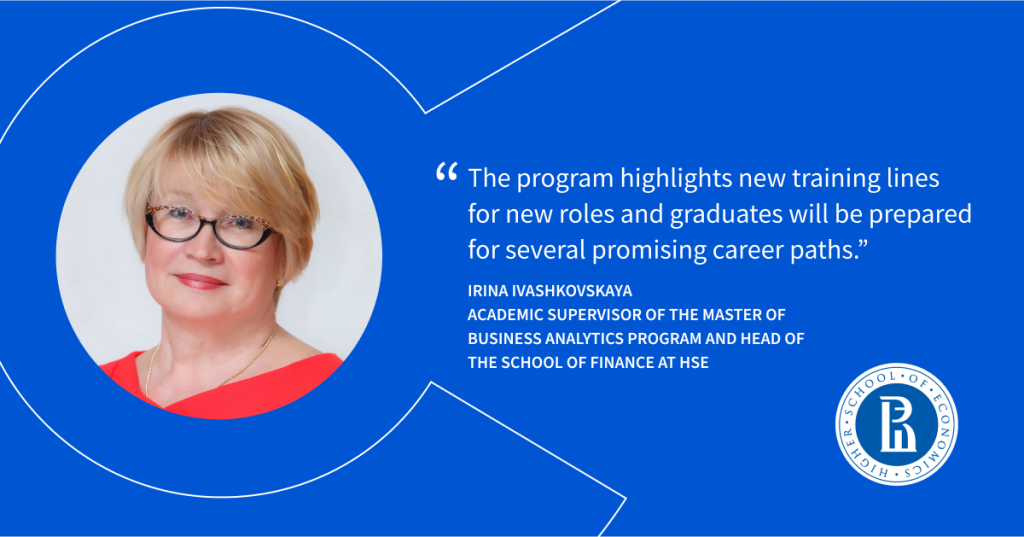
New Finance and Business Analytics Career Opportunities: An interview with Professor Irina Ivashkovskaya, Head of the School of Finance at HSE and Academic Supervisor of the new Master of Business Analytics program

In the fall of 2021, the first enrollees in the Master of Business Analytics program from HSE will commence their studies on the Coursera platform. Students in this groundbreaking program will develop innovative new skills uniquely relevant to a rapidly evolving global business and financial landscape. 

The program’s approach— implemented in cooperation with international professional networks such as ACCA, AICPA-CIMA, and IMA— is rooted in three core principles about the role of finance and business analytics:

  1. Finance should provide the measures for intellectual capital generated and accumulated by non-financial stakeholders. 
  2. Finance should offer the pricing models for new risk drivers derived from companies’ intellectual and natural capital.   
  3. Finance should play the role of integrator between non-financial and financial capitals and provide the models to secure the connectivity between non-financial capitals and future financial performance. 

As the global market economy continues to be reshaped by new challenges, HSE recognizes that exciting new career opportunities are emerging in the wake of these disruptions. The program is structured in such a way that you can learn the most essential skills for success in these new roles. The program offers two specializations: Value-Based Business Analytics and Strategic Business Reporting. As you progress through the program, you’ll take a balance of compulsory and elective courses, engage in interactive Virtual Labs, and participate in project workshops where you’ll complete two real-world projects under the supervision of industry experts. Upon earning your degree, you’ll learn the skills needed to succeed in a range of positions. These include financial management roles, roles at investment banks or investment funds, positions within accounting departments, and consultancy roles.  

We spoke recently with Professor Irina Ivashkovskaya, Head of the School of Finance at HSE and Academic Supervisor of the new Master of Business Analytics program. Over the course of our discussion, she offered her insights into the program’s focus, the new career opportunities she sees emerging in the fields of finance and business analytics, and the value of innovative new learning tools like Virtual Labs.

Professor Ivashkovskaya, thank you so much for taking the time to talk with us about this exciting new program. Let’s start with the basics; can you tell us a little bit about the focus of the program?

The Master of Business Analytics program is centered around developing new competencies for integrated thinking in analysis and decision-making, and connecting the measurement and evaluation of financial forms of capital (debt and equity) and non-financial capitals. Today, this kind of integration is becoming a core competence requirement for those who set out to join top management or boards of directors of companies, banks, or consultancy companies. It is no longer realistically possible to become successful in business and grow professionally without focusing on the integration of financial and multiple forms of non-financial capital. This entails the interests and benefits of not only investors and owners, but also non-financial stakeholders.  

Given the program’s future-facing nature, what do you see as the points of connection between the “new” and the “old” in terms of how people should pursue career advancement?

Well, this master’s program is aimed at new groups of competencies in areas which, at first glance, actually do belong to traditional professional tracks, such as financial management, accounting, and reporting. The key difference is that the program highlights new training lines for new roles that correspond to new international practices. The result is that graduates will be prepared for several promising career paths.

Can you give us a specific example of one of these new career paths?

Let’s take financial management as an example. With financial management, the central challenge is to have a methodology for analysis that integrates financial and non-financial capital and aims to add value to the business, taking into account the interests of different stakeholder groups over the long term. In the near future, this will become the work of the Chief Value Officer (CVO)—a role that will ultimately replace the Chief Financial Officer (CFO). This professional trend will also require a new approach to budgeting and modeling in order to achieve sustainable company value in the long run.

You mentioned the transformation from CFO to CVO; are there other new roles you see emerging?

Yes, absolutely. Another new position that is taking shape is that of the ESG Director (Environmental, Social, and Governance). This is someone who can provide a new quality of management for the company’s different capitals to achieve specific environmental, social development, and board role targets. 

If financial management is one of the main professional tracks where you’re seeing evolution and innovation, are there others?

Yes, I’d say a second area of change is related to accounting and reporting. Different forms of non-financial reporting are developing rapidly. It is not just a matter of adding more sections to a company’s current reporting. It’s about a new quality of reporting. Reporting needs to become holistic, integrating non-financial capitals, their risks, and their impact on financial results—both current and future.

A third area of change is innovation in risk management. New integrated risk management concepts and tools are being developed and modeling can now take into account risk factors hidden in non-financial capitals. 

A final area where we see change is in compliance. Compliance is transforming from a static function of fixing right and wrong practices into a function of maximizing value for both investors and other stakeholders through best ethical business practices that meet ESG criteria. Compliance needs to focus not just on a company’s risks, but on long-term business value growth. It is a field that is increasingly connected to financial knowledge and skills. 

We’ve talked at length about the changing landscape of finance and business analytics and the emerging professional tracks that students can pursue. Let’s switch our focus a bit and talk about the program itself. Specifically, can you tell us a little bit about Virtual Labs? What are they, and how do students benefit?

Virtual Labs are a new format that we created with international experts from Europe, the United States, and Asia. In live dialogues with students, these international experts can share their perspectives on emerging trends and provide insight into how they’re solving new business analytics challenges. We have also introduced project-based seminars in which international business experts representing the latest professional tracks in finance lead live virtual workshops. These experiences become tools that teams can use to organize their creative work on project topics within specializations.

It’s a great example of how an online learning platform can make new kinds of experiences possible. 

Yes, the modern world is dictating new formats for delivering education. In an environment of uncertainty and multitasking, online education is becoming increasingly important. Fortunately, thanks to the “learn from anywhere with a flexible schedule” format and the well-established set of digital tools that Coursera offers, we’re able to provide students with innovative, world-class content via a platform that aligns with their lifestyles and goals. Just as the professional trends we’ve discussed represent the new mainstream for finance and business analytics, online is swiftly becoming an important tool for professional degree-level learning.

~

We’d like to thank Professor Irina Ivashkovskaya for sharing her perspectives and insights! Enrollment is now open for the Master of Business Analytics program from HSE University. HSE has long been one of the most prestigious universities in Russia, and in 2020, HSE earned the first place spot on Forbes’ Best Russian Universities list. Learn more today!

« Previous Page
Next Page »
Coursera

Coursera was launched in 2012 by Andrew Ng and Daphne Koller, with a mission to provide universal access to world-class learning. It is one of the largest online learning platforms in the world, with millions of registered learners and thousands of institutional customers.

© 2025 Coursera Inc. All rights reserved.

Download on the App Store Get it on Google Play

B Corp
  • Coursera
  • About
  • What We Offer
  • Leadership
  • Careers
  • Catalog
  • Professional Certificates
  • MasterTrack™ Certificates
  • Degrees
  • For Enterprise
  • For Campus
  • For Government
  • Become a Partner
  • Coronavirus Response
  • Community
  • Learners
  • Partners
  • Developers
  • Beta Testers
  • Translators
  • Tech Blog
  • Teaching Center
  • Connect
  • Blog
  • Facebook
  • LinkedIn
  • Twitter
  • Instagram
  • More
  • Press
  • Investors
  • Terms
  • Privacy
  • Help
  • Accessibility
  • Contact
  • Articles
  • Directory
  • Affiliates