
The Carlos Slim Foundation, one of Mexico’s top philanthropic organizations, is Coursera’s major partner in the Spanish-speaking world. Our partnership aims to improve access to education among Spanish speaking learners, as well as support opportunities for career development and employment throughout Latin America.
Earlier this week, August 12th, The Carlos Slim Foundation unveiled Acceso Latino, (taken from their Press Release): “a free website
created to provide U.S. Latinos easy access to tools and content about education, healthcare,
job training, culture and more. This site will serve as a valuable resource to help Latinos succeed
in the United States.
“We’re proud to launch Acceso Latino, a completely free website that can provide Latinos
access to better opportunities through education, learning English, and job training,” said Carlos
Slim Helú. “Acceso Latino will put valuable knowledge at the fingertips of everyone who wants
to learn new skills and engage with their community. It is a simple but powerful resource that
can potentially help millions of people improve their lives.”
At over 40 million people, Latinos make up the largest ethnic minority in the United States.
That’s why Acceso Latino was created: to provide a support network for this growing and
developing community. Today, 80% of adult Latinos say that they are able to connect to the
Internet. Yet many of them still struggle to find access to high value information that they can
use to improve their lives and those of their families.
The Carlos Slim Foundation has identified a number of areas that are most associated with long-
term success. Acceso Latino will provide content, free of charge and in Spanish, in each of these
critical areas:
Online job training for in-demand employment, both in the United States and in their
country of origin, as well as information about financial literacy. Today, Latinos comprise
nearly 20% of the American work force, and this website will help them become better
equipped to succeed.
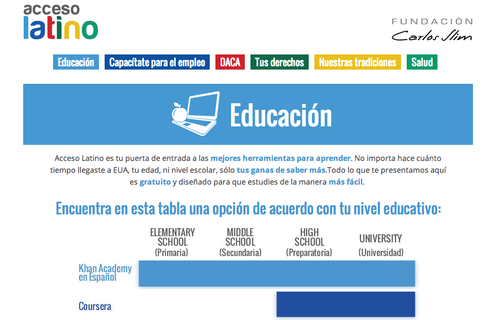
Academic education from elementary to the university level provided by Khan Academy,
MIT-Open Course Ware, Coursera and Académica, that includes courses from top level
universities such as Harvard, Stanford and Mexico’s National University, as well as
original materials. Today less than 55% of Hispanic students graduate from high school.
Materials provided through Acceso Latino will help more students build the skills they
need to succeed.
Online resources for learning English and subjects like American history and civics.
Health care information on common topics, including professional medical advice on
maintaining a healthy lifestyle for the whole family. Better health education and
awareness can prevent chronic disease and unnecessary emergency room visits.
Information on human and labor rights.
Acceso Latino displays information in an easy-to-use format on each topic, complete with videos
that walk users of any skill level through a step-by-step process. Acceso Latino is a collaborative
effort with organizations that work with the Latino community across the United States.
Dr. Roberto Tapia-Conyer, CEO of the Carlos Slim Foundation, explained how anyone can access
the website. Dr. Tapia said. “Acceso Latino was designed with everyone in mind. No matter your
nation of origin, age, level of ability, or ultimate goal, the website has something for you.”
Visit the website at accesolatino.org”
About the Carlos Slim Foundation
Created in 1986 to impact the most vulnerable populations, the Carlos Slim Foundation has
directly benefited millions of people. With a marked sense of social responsibility, efficiency,
and proven results, the Foundation has programs in various fields, such as education,
employment, health, nutrition, social justice, culture, human development, support during
natural disasters, protection and conservation of the environment, and economic development.
These programs help improve the quality of life for populations of all ages, fostering the
development of human capital and generating opportunities for people, their communities, and
their countries.