Coursera
  • Find a Course
  • Sign Up
Coursera Blog
  • Degrees
  • For Business
  • For Educators
  • Product News
  • Stories

Teach Computer Science to High Schoolers Using Coursera

February 13, 2014

Share
Share on Facebook Share
Share on TwitterTweet
Share on LinkedIn Share
Send email Mail

computersciencehighschool

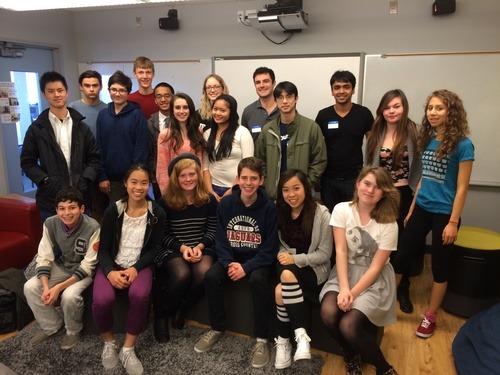
High school students at the French American International School in San Francisco learned the computer program language Python via free course material on Coursera.

A few months ago Seth Hubbert, the Director of Academic Technology for French American International School in San Francisco, got in touch with us with an interesting idea.

Seth had an idea to form a club of students that would learn Computer Science by taking An Introduction to Interactive Programming in Python from Rice University together.

High Schools around the world often find it challenging to offer classes in the most recent computer science fields, despite high interest from students. Seth was creative in overcoming these limitations and preparing his students with cutting-edge skills for when they graduate.

Hi Seth, can you please tell us a little more about yourself and the French American International School? What is your background in Computer Science?

I’m a former chemistry and physics high school teacher, and now work as the Director of Academic Technology for French American International School. Our school is an independent Pre-K through 12th grade school in San Francisco. We deliver a rigorous bilingual immersion program through middle school, culminating in either the French Baccalaureate or International Baccalaureate program.

I don’t have a very extensive background in Computer Science. I took a couple of undergraduate courses while earning a B.S. in Physics, but haven’t touched it much since then. I was learning right along with the students!

Tell us a little more about your class/club? How did it work?

The club was comprised of 25 high school students interested in gaining exposure to coding. We agreed to sign up and work through the Introduction to Interactive Programming in Python Course. To support one another, we agreed to meet physically twice a week to help each other with the content and stay on track and motivated.

“I was surprised by the number of students that earned their certificate! I’m extremely proud of their dedication and their skill as programmers!”

Seth Hubbert, the Director of Academic Technology for French American International School

What were the results like?

I was quite impressed with the dedication of the students! 20 of them (10 male, 10 female) finished the course with high enough marks to earn a Verified Certificate.

What was the biggest surprise for you?

I was surprised by the number of students that earned their certificate! They are all incredibly busy and have full course loads. I imagined some of them would use this as an opportunity to get a peek at some coding content, without fully committing to the 5-plus hours a week required to stay on top of the work, but I was wrong! They all took the challenge and often gave up their Friday and Saturday nights to fine-tune their projects. I’m extremely proud of their dedication and their skill as programmers!

What worked well? What advice would you give to teachers interested in replicating your program at their school?

I think having the face-to-face check-in times was key. I think it was beneficial not only for them to get help from each other when needed, but for the social motivation to stick with the course, knowing their peers had made the same commitment. I also was adamant that they not see me as a traditional content-expert teacher. I wanted them to see me as a coach, motivator, mentor, etc., and this helped them rely more on each other for help and support.

What’s next for some of your students? What’s next for you and the club?

Soon we plan on launching a spring version and bringing a few more interested students into the fold that missed the first opportunity. A majority of students that completed the Python course are interested in going deeper, and continue taking other programming MOOCs to develop their coding skills!


Are you a teacher with or without computer science background, but still want to try teaching Computer Science to your students? The always popular An Introduction to Interactive Programming in Python from Rice University is starting next month.

Learn More on the Course Page >>
Share
Share on Facebook Share
Share on TwitterTweet
Share on LinkedIn Share
Send email Mail

Keep reading

  • 2026’s Fastest-Growing Skills and Top Learning Trends From 2025
  • Empowering leaders to build a skills-first future
  • Celebrating 10 million GenAI enrollments on AI Appreciation Day
  • New on Coursera, Google Agile Essentials course helps professionals deliver projects and results faster
  • 2024’s Rising Content and Fastest Growing Skills for 2025
  • Wharton Online and OpenAI launch a new course on Coursera, “AI in Education: Leveraging ChatGPT for Teaching”
  • Announcing 10 entry-level Professional Certificates from our biggest partners as digital transformation reshapes the labor market
  • Google launches Prompting Essentials course as demand for AI skills continues to grow
  • Coursera celebrates AI Appreciation Day with new GenAI courses, Professional Certificate enhancements, and GenAI Academy for Teams
  • Presenting the 2024 Coursera Global Skills Report
  • Coursera launches a new suite of Academic Integrity features to help universities verify learning in an age of AI-assisted cheating
  • Announcing four new entry-level certificates and Universal Skills scholarship program from Microsoft to help learners land in-demand jobs
  • Clemson University partners with Coursera to launch first degree in South Carolina with no application*
  • Google launches AI Essentials course on Coursera to help learners boost their productivity and thrive
  • Twelve Google and IBM Professional Certificates on Coursera receive ECTS credit recommendations
  • Coursera Launches Generative AI Academy to Improve Executive and Foundational Literacy 
  • Introducing “Navigating Generative AI: A CEO Playbook” 
  • Nevada DETR and Coursera announce statewide program providing free job training to thousands of people 
  • University of Texas System and Coursera Launch the Most Comprehensive Industry Micro-Credential Program Offered by a U.S. University System
  • Coursera announces new AI content and innovations to help HR and learning leaders drive organizational agility amid relentless disruption
  • New Coursera survey shows high demand for industry micro-credentials from students and employers in tight labor market
  • Coursera and Google partner with the University of Texas System to provide critical job skills to students across eight campuses  
  • What the world learned on Coursera in 2022
  • Coursera partners with state university and workforce systems to prepare Louisiana’s workforce for jobs of the future 
  • Connecting Google certificates and university Specializations to help learners prepare for in-demand career fields
  • Coursera partners with IFC and the European Commission to publish global study on women and online learning in emerging markets 
  • Coursera Launches Clips to Accelerate Skills Development through Short Videos and Lessons
  • Preparing learners around the world for in-demand jobs with Career Academy and new entry-level certificates from Meta and IBM
  • Coursera and Milken Center for Advancing the American Dream launch free nationwide skills training initiative for underserved Americans 
  • Coursera’s response to the humanitarian crisis in Ukraine
  • Coursera announces 3 new job-relevant degrees from leading universities
  • Coursera doubles down on Middle East with new leadership, content and platform features
  • Coursera Women and Skills Report indicates a narrowing gender gap in online learning
  • Coursera accelerates India growth plans
  • Announcing the Coursera Global Skills Report 2021
  • Turning Entrepreneurial Ambition into Global Impact
  • Introducing Coursera’s Job Skills Report 2026: The most critical skills the world’s learners need this year
  • Cleveland Clinic joins Coursera to teach the latest healthcare skills at a global scale
Coursera

Coursera was launched in 2012 by Andrew Ng and Daphne Koller, with a mission to provide universal access to world-class learning. It is one of the largest online learning platforms in the world, with millions of registered learners and thousands of institutional customers.

© 2026 Coursera Inc. All rights reserved.

Download on the App Store Get it on Google Play

B Corp
  • Coursera
  • About
  • What We Offer
  • Leadership
  • Careers
  • Catalog
  • Professional Certificates
  • MasterTrack™ Certificates
  • Degrees
  • For Enterprise
  • For Campus
  • For Government
  • Become a Partner
  • Coronavirus Response
  • Community
  • Learners
  • Partners
  • Developers
  • Beta Testers
  • Translators
  • Tech Blog
  • Teaching Center
  • Connect
  • Blog
  • Facebook
  • LinkedIn
  • Twitter
  • Instagram
  • More
  • Press
  • Investors
  • Terms
  • Privacy
  • Help
  • Accessibility
  • Contact
  • Articles
  • Directory
  • Affiliates