
Editor’s note: Sankalp is a student who recently wrote about his journey through a UPenn Coursera Signature Track course. Sankalp and his friends have taken Coursera’s vision to heart and rallied an entire organization in India to empower a large community of younger students in Mumbai to learn more about MOOCs! Read more about how one Courserian turned a vision into a working reality!
“We envision a future where everyone has access to a world-class education that has so far been available to a select few. We aim to empower people with education that will improve their lives, the lives of their families, and the communities they live in.” – Coursera’s Vision Statement
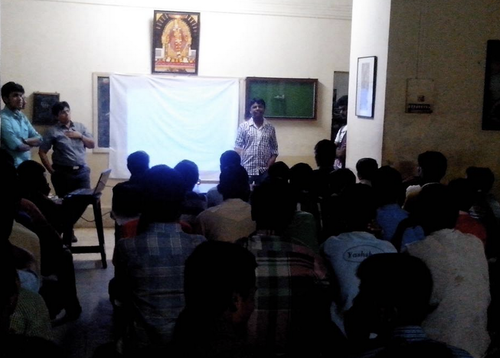 As a student in India, Coursera gave me the opportunity to learn on my own time. I experienced the sheer pleasure of learning when I took Intro to Mathematical Thinking last fall and Calculus: Single Variable this past January. After taking Coursera courses, I felt empowered. I believed that every student in India should know about Coursera and other educational resources online, like Khan Academy and YouTube learning channels. So, I decided to live up to Coursera’s vision and do something to give back to the community I live in. I combined my experience with computers and Photoshop to lead an education session for younger students at my school. Here are the steps I took to apply my Coursera knowledge to empower my community:
1. Spreading the Word
I got together with a few of my friends (all my grade level) to create a “Computer Geek Award,” and my aim was to teach kids how to use the sites like Coursera, WolframAlpha, Khan Academy, and TED at my school. To make the session interesting, we incorporated a quiz, in which the winner got a handmade trophy created by our crew, a team of students devoted to spreading the word about online education.
This was very successful at my school, and we started going to different schools, talking to educators about the flipped classroom model and demonstrating online resources to kids, enabling them to scratch the surface of higher education. We loved seeing the smiles on the children’s faces when we introduced the rich material to them. 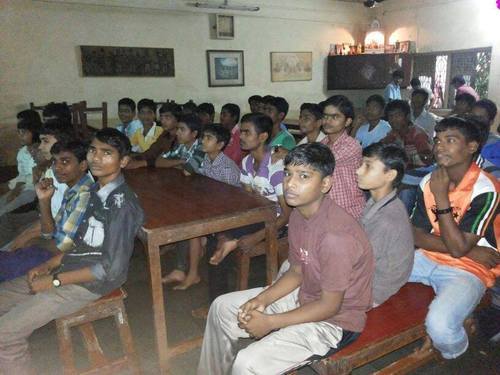
This is a picture taken of us speaking to students at an Orphanage in
Mumbai last week (Aditya Birla Centre for Children’s Welfare)
2. Overcoming Challenges by Being Creative
There were several disadvantages that we had to overcome when we started going to schools more broadly:
• We could only teach a maximum of 60 students per session.
• It was often a one man show. I did all the talking, and in spite of having a talented crew, they were just used to maintain discipline in the session hall.
•There was no way to control attention loss. The kids had no way to repeat and rewind in case they missed any material.
To solve some of the issues we faced, we decided to make short videos about the material!
Here is an example of a video we made based off of what we learned in
Coursera’s Single Variable Calculus Course.
[Huge shout out to Professor Ghrist for teaching us how to teach!]
Our other videos can be seen here. Inspired by the model of other online education sites like Coursera, we branched out to teaching other subjects, and tried to explain concepts in a way that got students interested in learning to get them to use Coursera and Khan more. We even gave our group a name: TAPtheTECH.
3. Personal Learning and Education for Everyone
The current education model strongly discourages students from taking on time-consuming creative endeavors, but we organized as a team to divide the work of creating videos. We knew that our work was not just a matter of personal interest, but something that had the potential to education many students.
TAPtheTECH is teaching us, the video creators, as well as students! We take courses from Coursera to get a better understanding of the material and then use those concepts to make our videos more relevant to India students. Aside from purely academic skills, TAPtheTECH also teaches us people management and professional skills. Through TAPtheTECH, I have been able to teach programs like Photoshop, Illustrator and Flash to many kids. No high school in India teaches these, and design and VFX classes cost a lot of money. Through our videos, students are gaining skills that will help them apply to college and get good jobs.
4. Overcoming More Hurdles, One Step at a Time
While we were really excited to implement the flipped classroom model in Indian classrooms, we faced some rejection and difficulty in getting schools involved. Inspired by TED Talks from Sir Ken Robinson, Sal Khan, and Prof. Daphne Koller, we are determined to change the education system. But many schools were hesitant to let us speak to their students, especially when they thought that we were trying to sell videos. We try to explain our cause, and that we are there to promote the cause of education for free.
Despite these hurdles, we believe that persistent efforts will get us there. Initiatives like Coursera coupled with community engagement can solve a lot of problems in developed and developing countries. For example, right now India is facing a primary teacher shortage. I see the potential solution to come from educational videos; imagine each and every kid getting education by taking courses online!
5. Getting Involved Wherever You Are:
Teenagers and adults worldwide can come together not only to watch videos, but also to create them and spread the word. Imagine the design of a video created by one teen in Mumbai and animated by another in New York! In this manner, the world can unite for the cause of education. We talk about dissolving the boundaries between nations, and this can certainly be true when it comes to online education.
My concluding words are for students all over the world – the hidden protagonists. If you are interested in doing something, join us! Send a message on facebook or sankalp[at]tapthetech[dot]org.
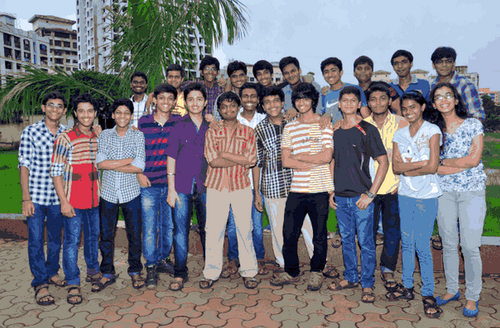
Thanks for reading our blogpost, everyone! -TAPtheTECH Team