

By Jeff Maggioncalda, Coursera CEO
Today, the World Economic Forum (WEF) launched its Future of Jobs Report 2023 that analyzes the impact of current labor market disruptions and reveals the outlook for technology adoption, jobs, and skills in the next five years. Coursera is honored to partner with the WEF to conduct research for the report and demonstrate how skills-based approaches to workforce development can help displaced workers transition into jobs of the future.
Digital transformation, automation, and globalization are creating a skilled worker shortage and an unprecedented need for reskilling and upskilling globally. The breathtaking rise of generative AI further compounds the urgency, as a new class of knowledge workers is now at risk of displacement. The Future of Jobs report forecasts that over 60% of workers will require retraining between now and 2027, but only half of workers are seen to have access to adequate training opportunities today.
Coursera data in the Future of Jobs report provides valuable insights that can guide the development of reskilling strategies for displaced workers. Among the key findings from our research:
Learners without degrees took roughly the same amount of time to acquire key skills as those with degrees
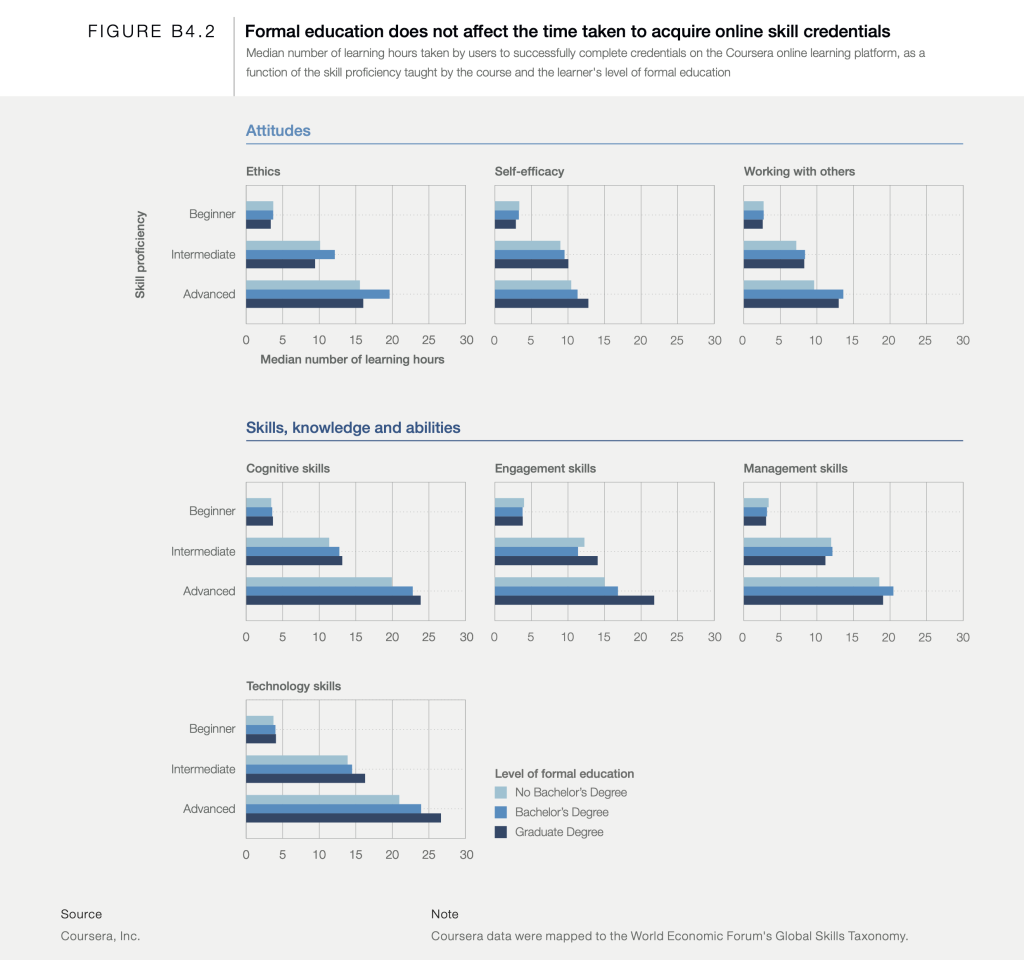
The median number of learning hours taken by learners to successfully complete credentials on Coursera shows no evidence that learners without a degree take longer to achieve beginner, intermediate, or advanced proficiency in any skill. This finding highlights the significant potential for skills-based approaches such as industry micro-credentials and skills-based hiring to tackle skills gaps and talent shortages.
Collective action is needed from the public and private sectors to provide affordable and flexible reskilling pathways for impacted workers. Governments and higher education institutions need to deliver relevant and scalable workforce development and academic programs to address job dislocation and unemployment challenges. For employers, a skills-based talent approach can help expand their hiring pipelines and create reskilling pathways for employees to adapt to fast-changing workforce requirements.
Individuals have been prioritizing technical skills, but employers are putting a new emphasis on human skills amid rapidly-changing workforce needs
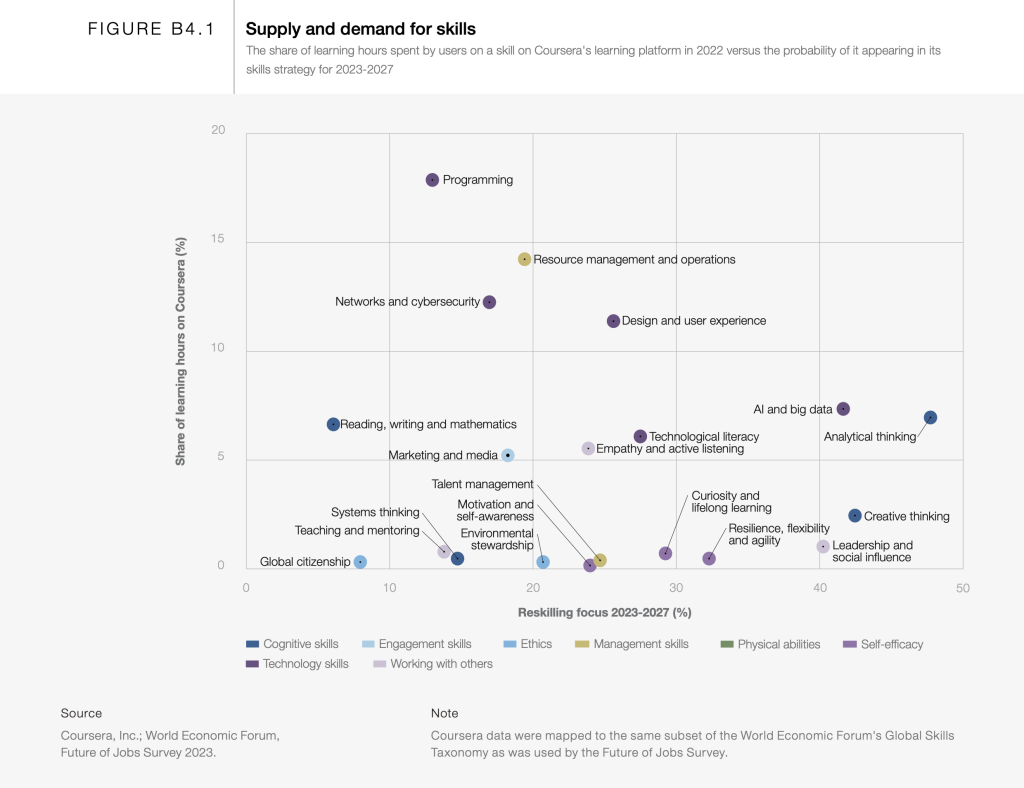
Individual learners on Coursera have mainly focused on building technical skills that are more commonly associated with good-paying, in-demand careers, such as programming, networks, cybersecurity, operations, and resource management. While these are not the top skills employers seek, per the Future of Jobs Survey, many are foundational to achieving advanced proficiency in high-priority skills like AI, big data, leadership, and social influence. Even though employers don’t explicitly list Reading, Writing and Mathematics as high priority skills, these skills remain an important foundation for any job seeker to thrive in the workplace.
Amid this period of rapid change and disruption, companies are placing greater emphasis on “socio-emotional” skills that allow their workforce to more effectively respond to change, such as resilience, agility, leadership, and analytical thinking. These “human” skills are less susceptible to automation and are increasingly important as the technology accelerates the rate of change. While technical skills still account for the majority of learning hours from individuals on Coursera, evidence suggests that it is equalizing, as socio-emotional skills have steadily increased their share of learning hours from 2017 to 2023.
While our research indicates that institutions and individuals should invest in both digital and human skills, there are still gaps in the skills individuals seek and the skills businesses prioritize, and institutions have an important role to play in supporting and empowering displaced workers with the right skills and credentials to succeed in the new labor market.