Coursera
  • Find a Course
  • Sign Up
Coursera Blog
  • Degrees
  • For Business
  • For Educators
  • Product News
  • Stories

3 Latinx product designers at Coursera share their career journeys and advice for entering the field

Are you interested in a product design career? In this post, we’ll share our conversation with three expert product designers to get some inside perspective on this high-demand field. They share advice and guidance on why this is a great career path, what skills and experience are most important, and how you can advance your career as a successful product designer.

Before we hear from our experts, however, let’s cover some product design basics.

What is product design?

Product design is the entire process of thinking, creating, and iterating products and experiences to solve people’s problems or anticipate user’s needs. 

What do product designers do every day?

No two days are the same for a product designer. On any given day, you might be busy collaborating with product managers to set product strategy, partnering with product researchers to understand user needs, or analyzing quantitative data to inform design decisions. You might have sessions with engineers and other designers to sketch new features and improve existing ones. Some product designers even create prototypes to run usability testing and iterate in their designs.

Why are diverse perspectives particularly important in product design?

Successful product design has a positive impact on consumer behavior, great product design makes for world-class experiences, and diverse perspectives make for more inclusive products. As more and more companies are realizing this, they are investing heavily in building high-skilled and diverse product design teams.   

Now, let’s hear from Coursera product designers Tatiana Londoño, Adriana Phillips-Guzman, and Alberto Guzmán!!

Each is an expert in their field, and also a member of the Latinx community. As we celebrate Hispanic Heritage Month, we’re excited to bring forward their perspectives as they help shape designs for Coursera’s global platform. With Latin America and the Caribbean making up 8.42% of the world’s population, having diverse perspectives in design is critical to building more inclusive products that can help learners everywhere learn without limits.

Can you tell us a bit about your journey into product design?

[Tatiana]

I majored in engineering, but it wasn’t until I took a class on product design that something clicked for me. I could finally see a path towards opening more doors for those who had been left behind. Almost a decade after graduating from university, I’m on my fourth job in the EdTech industry. Every single job has taught me something. The EdTech space is full of complexities and opportunities. There are so many people in the world who don’t yet have access to quality education, which makes EdTech a huge opportunity for designers trying to lead the way in an industry that drives life-changing impact. 

[Adriana] 

My career has been full of new iterations—just like the design process! While not every iteration worked, I always learned something new to help me grow. With a visual design major, I began my career teaching design at a university in Cartagena. I was also working at a local newspaper. I met fantastic people in those jobs, but the work climate in Colombia—where we experienced late or missing salaries and a lack of security—led me to apply for a Fulbright scholarship. This allowed me to pursue my Master in Design Management at the University of Kansas. 

My time at KU opened my mind to new design methods. It was that experience that led me to value higher education—what it can do, and what it did for me.  

[Alberto]

I’ve been fascinated by the intersection of technology and people ever since I was really young. I didn’t know much about product design in college until I worked on business operations at an early stage startup where a friend of mine was a design director. I saw how he and his design team worked together to develop a product and how their work blended entrepreneurship, engineering, technology, visual design, sound design, and more.

I decided to formally pursue product design. I went back to school, and also started honing my visual design skills with freelance work for local organizations. After graduating, it took me about six months to get my first full-time design role.  

I developed my career at startups, and this allowed me to explore facets of design that are traditionally executed by specialists at bigger companies. Now, at Coursera, I’m in a more specialized role. I am growing my skills and getting exposed to so many different approaches to problems as I learn from other specialists that are experts in their field.

Can you share some tips for being a successful product designer?

[Tatiana]

Make it an intentional decision to deeply understand a problem before tackling it. Identifying and challenging your internal biases, tackling a problem with open-mindedness, and going to the source before starting to form assumptions should all be part of your playbook. Just as important, you should also have a deep understanding of the systems and technology on which your product is going to be produced. 

Every product needs a good foundation. Otherwise, anything you build on top of it will fall apart. So, before jumping into the visual representation of your product, ask yourself:

  • Is there the right information architecture to support it? 
  • Is the data you can provide aligned with the data users expect to see? 
  • Have you thought of all possible use cases your solution needs to support? 
  • How would those cases be handled? 

The best designers are willing to get down to every detail of a product to create the right solution for their users. They can tell you about the complexities of the backend and the data model that supports it, and how ultimately they were able to translate it into a simple and streamlined solution for users. 

[Adriana] 

Know your strengths and learn how to use them in your design process. Successful product design is best achieved with a design team effort that leverages individuals’ areas of expertise. So, it’s important that you bring not just your specific product design skills, but also the natural abilities you’ve always had, and your unique experiences. This will help you find your design voice and bring it to life in your work.    

Show Your Work. Don’t be afraid to start sharing your designs, even when you don’t think they’re good enough. Design is about iteration, and it’s important to hear what’s working and not working. Also, having worked with people from such diverse backgrounds, I’ve grown to appreciate that different perspectives can help improve designs and open new ideas. 

[Alberto]

Keep an open, curious mind and invite others into the process. Our jobs are more about finding the right answers than having the right answers right off the bat. This is done best when you break down organizational silos and work together with non-designers. 

It’s also super important to have a strong perspective and develop the confidence to share that. Early in your career, it’s easy to assume that your role is just to execute on what a company wants you to design. But, if there is something you believe really sacrifices the user experience of a product, it’s important to speak up and have that hard conversation as early as possible. 

Finally, I’ve found that it’s important to build empathy for your cross-functional teammates so you can understand the roles they play in the UX. 

What career advice would you give for those who are interested in getting into product design?

[Tatiana]

Focus on communication skills. A big portion of the designer’s job is to communicate. Whether you are doing a user interview, convincing stakeholders of a certain direction, presenting your work, or doing a pairing session with a developer, communication is a key skill we rely on all the time as product designers. 

The process of becoming a better communicator for me has involved multiple facets. I had to feel more comfortable in my own skin, learn to appreciate my own point of view as valuable, get over the fear of speaking in a second language, and finally learn to structure my speech in a way that is optimized for impact. 

I’m being vulnerable here because I want to assure those who might be doubting themselves that although a big portion of the job as a designer is to communicate, you don’t need to be born naturally into it. Just like any other skill, it can be built and perfected, and even the most skillful communicators are still learning new things every day. 

[Adriana] 

Read. When you’re done reading, read more. When I began working as a product designer, the first thing I did was read three books about it. I was determined to be the most prepared person in the room, and the books I read prepared me for that. It worked so well, I haven’t stopped.

Get into projects and communities that will grow your skills. One of the most rewarding things I did after moving to Boston was to volunteer for Make a Mark Boston and work with Moms as Mentors. I made connections, grew and applied my skills, and soaked in the positivity of what I was doing. Making connections is huge. Most good opportunities come from people you already know. I’ve also joined the UXPA Boston Board for the same reason. 

[Alberto]

Start designing ASAP! There are a lot of layers to design and it can get overwhelming, but what’s most important is starting somewhere, wherever, and not being afraid to ask for help and feedback. Like I said earlier, the job of designers isn’t necessarily to have the right answers right off the bat, but to find the right answer. Finding the right answer gets easier when you detach yourself from your designs and allow the feedback to inform how you move closer to your solution.

So much of design is simply becoming more sensitive to details in everyday things that you hadn’t perceived before. But it’s hard to build that muscle without getting your hands dirty!

What are some of the challenges you faced as a Latinx product designer, and how did you confront those challenges?

[Tatiana]

Women’s representation in tech is low, and Latinx representation is lower. I often find myself in rooms where I’m the only woman, and almost always the only Latinx woman. I was too conscious of this earlier in my career. I could see how articulate some of my teammates were, and I thought it was impossible for someone who learned English as an adult to ever be like that. There was also the cultural context I came from, where as a Latinx woman I was encouraged to be quiet and to defer to men. Overcoming my impostor syndrome took lots of self-discovering and self-empowerment. It wasn’t until I believed I had something important to say that others started to believe it, too. Some of these people eventually became mentors and advocates who helped me polish my skills and who gave me a platform to showcase my best work.

[Adriana] 

When I started my career, I was the only Latinx woman on my team. I didn’t feel listened to or respected. Oftentimes, I was interrupted by my teammates and I felt like I had to shout over people to get attention. That didn’t match who I was as a person or as a designer. At one point, I was told I wasn’t being promoted because of my “language barrier,” which was code for having an accent. I had to lean on my support system and find a better fit for me.  It took a toll on my confidence at first. But I found a place that respected me and helped me  grow my confidence again. I learned to take my space and make my expectations clear. It was the first time I was comfortable with bringing my authentic self to work. 

[Alberto]

My early career was very grounded in fear. Fear of slowing my team down. Fear of having “bad” ideas. Fear of getting my design work steamrolled. Fear of getting uncovered for not being a real designer—whatever that means. 

Looking back, I wanted to be seen and heard, but that requires levels of vulnerability that I wasn’t comfortable with when I was in a room full of people in a foreign-feeling work culture that I was always trying to adapt to. 

Over time, I found communities and mentors that helped me to learn from those that had navigated similar obstacles and to feel heard by people I felt comfortable being my absolute full self with.

Why is it important to have more diversity and representation in the product design space?

[Tatiana]

So many reasons! If you are to build a product that will truly reach a global audience, you can’t design it in a vacuum. Access to technology, connectivity, and even cultural conventions affect how a learner consumes educational materials. These are all things we can teach ourselves to empathize with, but there is nothing more powerful than having a member on our team who has lived through it and can provide firsthand experience that will bring the solution to the next level. 

Another important reason for diversity and representation is that there is power in the resilience that underrepresented groups bring. I have seen it over and over again. People who had to go through a lot to get where they are, are extremely disciplined and resourceful. I see it every day in the Latinx community, which is filled with innovators. We have a saying in Colombia: “If we don’t know it, we’ll invent it.” I grew up with this mentality. My house was the ultimate museum of hacks. Everywhere you looked, you could see the inventions my parents came up with to make up for the lack of resources. 

[Adriana] 

People empathize best with experiences they understand. A wider variety of perspectives and experiences makes for a more empathetic product design team, which will result in a better product. In my role at Coursera, I can empathize with those trying to get an education in a developing country because I’ve lived that experience.   

[Alberto]

The key to nailing a user experience lies in deeply understanding the problem your audience is facing, which requires tremendous empathy and curiosity. It’s important to have a product team that is as diverse as the audience it serves in order to ground the team in empathy for what’s really going on in the lives of the people you’re trying to help.  

~

We want to thank Tatiana, Adriana, and Alberto for sharing so much of their lives, insights, and experiences, and we hope their perspectives have been valuable as you consider your own future in product design.

If you’re interested in learning essential skills to advance your product design career, we recommend exploring the Google UX Design Professional Certificate program. UX is a critical part of product design, and user experience (UX) designers focus on the interactions that users have with products like websites, apps, and even physical objects. It’s an excellent program for anyone eager to build job-ready skills in this rewarding field.

If you’re a product designer interested in furthering Coursera’s mission of transforming lives through learning, then good news! We’re hiring product designers––we’d love for you to apply here.


About these experts

Tatiana

Tatiana Londoño is a Senior Product Designer focusing on the educator experience. Her main focus is on designing the tools partners use to create and manage courses. Her passion for education has made Coursera the fourth EdTech company she has worked in as a product designer. Prior to Coursera, Tatiana led product design for the learner experience of Khan Academy. Tatiana is passionate about scaling education with the power of technology to reach every corner of the world. Close to her heart are under-resourced communities, like those in her native Colombia. 

Adriana 

Adriana Phillips-Guzman is a Senior Product Designer focusing on the learner experience. Her area of focus is the mobile experience design for native apps, visual design, and brand building. Aligned with Coursera’s mission to provide equitable global access to education, she is focusing on finding ways to make it easier for international learners to continue their education using our native apps. Prior to Coursera, she led key e-commerce experiences at Wayfair. In her current role at Coursera, she is combining her passion for helping others through education with the creation of experiences that enhance people’s lives.

Alberto

Alberto Guzmán is currently a Senior Product Designer at Coursera, focusing on the payment experience. He builds self-service tools that Coursera learners use to understand and take action on their Coursera transactions. Prior to Coursera, Alberto led design at a hospitality startup called Pared. Alberto is moved by the opportunity to use technology to empower people to create and grow.
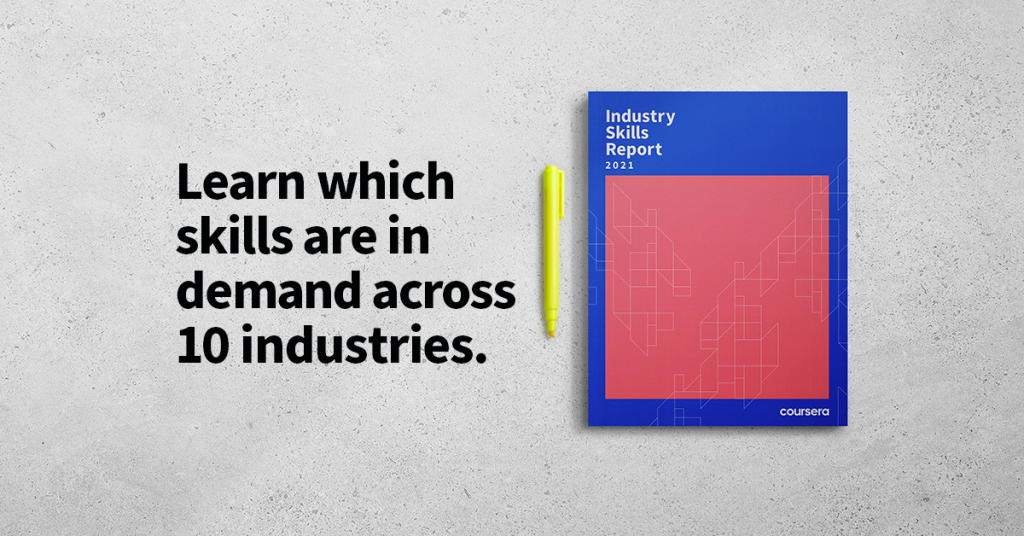
Coursera Industry Skills Report highlights critical skills gaps as digital transformation investments accelerate across all major industries

By Leah Belsky, Coursera Chief Enterprise Officer

I am excited to introduce Coursera’s Industry Skills Report 2021, which examines the pandemic’s impact on digital transformation and skills development across major industries. The report analyzes data on skills proficiency from millions of Coursera learners across 10 different industries between June 2020 and May 2021.

The pandemic has accelerated the rate of digitization on a global scale and dramatically changed the way businesses operate. Recent data shows that two years worth of digital transformation were concentrated between May-June 2020 alone. The Industry Skills Report helps companies assess skills gaps within their workforce and understand the critical skills needed to succeed in the new economy. 

Understanding the industry skills data

In the report, we highlight skills proficiency within each industry. This is calculated by grading all relevant skill assessments completed by learners in a specific industry. We then use machine learning models to estimate how proficient a learner is in a given skill. By taking the average of these individual scores, we are able to determine the industry proficiency level for each skill in the report.

The proficiency levels are represented as percentiles, which are grouped into the following four categories:

  • Cutting-edge: 76th percentile or above
  • Competitive: 51st–75th percentile
  • Emerging: 26th–50th percentile
  • Lagging: 25th percentile or below

Among the major trends that the Industry Skills Report identified include: 

Automotive companies show growth across multiple skills but lack proficiency in critical technologies. Digital transformation creates new skill imperatives as autonomous vehicles, high-efficiency electric car batteries, and connected cars become a priority. To stay competitive, automotive companies have developed cutting-edge technology and data skills such as machine learning (100th percentile), mobile development (100th percentile), and computer programming (78th percentile). However, to build business agility and keep pace with rapid change, automotive companies must strengthen development in several critical skills, including cloud computing (11th percentile), security engineering (44th percentile), and data visualization (22nd percentile).

Manufacturing shows improved proficiency across business, technology, and data skills as it increases the adoption of smart manufacturing, smart factory, and robotics technologies. Companies in the industry have demonstrated cutting-edge skills in strategy and operations (100th percentile), software engineering (100th percentile), and data visualization (78th percentile). Despite improvements, the skills gap and labor shortage in the industry remains a concern. To ensure employees have the skills needed to fill critical roles and improve internal mobility, companies must strengthen proficiency in areas like cloud computing (44th percentile), probability and statistics (44th percentile), and statistical programming (33rd percentile).

Financial Services doubling down on technology and data skills as it navigates disruption caused by changing user behavior and platform shifts. As more financial services companies implement cloud computing, cybersecurity, AI, and machine learning technologies, there are rising concerns about the skills gap posing execution risks. The industry is prioritizing development in critical technology and data science skills, including data management (100th percentile), security engineering (89th percentile), and mobile development (89th percentile). The ability to quickly adjust business strategy to create competitive advantages will require improvement in essential skills such as strategy and operations (44th percentile) and leadership and management (44th percentile).  

Professional Services companies must implement digital and virtual processes to supplement human interactions. Professional services is a relationship-driven industry that has relied heavily on in-person interactions. The pandemic and remote work environment are forcing these organizations to use technology in new ways to help build and maintain relationships with clients. Organizations have developed cutting-edge business skills in communication (100th percentile), leadership and management (89th percentile), and marketing (89th percentile). To drive continued growth, companies must implement digital best practices and improve automation by strengthening technical and data skills in mobile development (33rd percentile) and data management (11th percentile). 

Technology companies work to address the short shelf-life of skills with continuous development opportunities. The rapid pace of innovation and the decreasing shelf-life of technology skills will require companies to accelerate development efforts. As expected, the industry has many cutting-edge technology and data skills, including cloud computing (100th percentile), software engineering (89th percentile), and data management (78th percentile). However, to effectively deliver on strategic initiatives, technology companies must also improve critical business skills in low-performing areas such as human resources (22nd percentile), finance (11th percentile), and marketing (11th percentile). 

Telecommunications industry must increase technology and data skills to maximize growth opportunities around 5G Networks. The global telecom services market is expected to be valued at $2.5 trillion by 2028, and continued investments in deploying 5G wireless networks are a crucial growth driver. To deliver on this opportunity, telecom companies have developed cutting-edge technology skills in computer networking (100 percentile), security engineering (100 percentile), and cloud computing (78 percentile). The shift towards 5G networks will have massive data implications. To fully harness the power of their data and maintain a competitive advantage, telcos must significantly improve skills in data analysis (11th percentile), data visualization (11th percentile), and machine learning (33rd percentile). 

Despite the recent downturn, investing in job-based skills development remains a priority for many businesses. We are honored to work with industry leading organizations across the world to provide them with the high-demand skills needed to fill critical roles, deliver stronger business outcomes, and thrive in the digital economy. 

With over 87 million learners and 6,000 institutions subscribing to thousands of courses on the platform,  Coursera has one of the largest data sets for identifying and measuring skill trends. This report includes data from 40 million new learners who registered during the pandemic between Jan 1, 2020 and June 30, 2021.


To download the Industry Skills Report 2021 and explore the sector findings, click here.

Go to Coursera for Business

Trending online courses in cloud tech, sales, cybersecurity, and more

With more world-class content launching every week, there are always new topics to explore, new skills to learn, and new ways to achieve your goals. These latest courses, Specializations, and Professional Certificates cover everything from business management and personal finance to data science and sports analytics. What will you learn next?

Business

Google Cloud Digital Leader Professional Certificate from Google Cloud

Are you interested in learning how to maximize business growth opportunities through modernizing IT infrastructure and applications? Gain foundational knowledge about cloud technology and data from experts at Google. In this Professional Certificate program, you’ll get an overview of Google Cloud products and services and build the knowledge needed to confidently contribute to informed cloud-related business decisions. No prerequisites are required to enroll.

Business Management Certificate from the Indian Institute of Management Kozhikode

Develop the skills necessary to succeed in a top-level management role. Expand your skill sets in finance, marketing, data analytics, and more as you advance your business management skills to become an impactful leader. Upon completion of this program, you’ll gain new management skills, a deeper understanding of global business, and advanced insight into effective growth strategies, as well as the ability to apply your skills and knowledge to drive success at your organization.

Intuit Bookkeeping Professional Certificate from Intuit

Skilled bookkeepers are needed in just about every business and industry (and that means job security!), and you can learn from the Intuit experts who created Quickbooks and Turbotax about how to interpret and analyze financial statements to make key business decisions. You’ll familiarize yourself with balance sheets, payroll procedures, and line-item invoices, and there is no previous experience or knowledge required to enroll.

Salesforce Sales Operations Professional Certificate from Salesforce and Pathstream 

Salesforce is one of the most popular and commonly used Customer Relationship Management (CRM) platforms in the world, and skilled users are in demand across industries. Prepare for a career as a Sales Operations Specialist and get job-ready skills for an entry-level role in this Professional Certificate program from Salesforce. You’ll learn the skills to support a sales team and gain hands-on experience using Salesforce software. Explore the sales process, learn how to create basic reports and dashboards, and build the confidence to manage customer relationships. 

Strategic Management Certificate from the Indian Institute of Management Kozhikode

In this program, you’ll build applied skills using the latest techniques and strategies for driving organizational growth and discover new approaches for designing, implementing, and executing corporate strategies to meet business goals. With the strategy and planning experience you’ll gain through earning your certificate, you’ll be prepared to advance your career and succeed in senior leadership roles.

The Fundamentals of Personal Finance Specialization from SoFi

Learn the money skills you need to take more comprehensive control of your finances. Across five courses, you’ll examine a range of personal finance topics, including budgeting, investing, and managing risk. Through readings, videos, and activities, you’ll build new skills and learn how to implement strategies to meet your financial goals.

Omnichannel Retail Strategy Specialization from the University of Pennsylvania Wharton

Learn how to develop a customer-focused strategy to increase customer satisfaction and retention in the retail industry. Gain fundamental skills and knowledge to navigate the retail space and maintain a successful organization, and discover what marketing practices drive organizational success in a rapidly evolving retail industry. No prior experience is required to enroll.

Product Management Certificate from the Indian Institute of Management Kozhikode

Whether you’re a product manager looking to advance your career, an entrepreneur or business owner committed to growing your business through effective product strategies, or a professional making a career change, this certificate program is for you. In this program, you’ll gain an understanding of Agile product development frameworks by developing prototype products, and learn strategies to enhance user experience and drive business growth. This program is an ideal way to build the necessary skills to qualify for high-impact product management roles.

Excel Skills for Business Forecasting Specialization from Macquarie University

Learn how to confidently use Excel to solve common business problems and develop forecasts. In this new Specialization from Macquarie University, you’ll build essential Excel skills and explore advanced data features. You’ll learn how to design sophisticated spreadsheets and dashboards, perform complex calculations, and manage large data sets. Best of all, you’ll practice your skills through hands-on Excel assignments. No prior experience is needed to enroll.

English Language Skills A2-B1 CEFR: Low-Intermediate Specialization from Voxy

Strengthen your English language skills for your professional and personal development and become an effective communicator. In Voxy’s new Specialization, you’ll learn how to communicate clearly through written emails with colleagues, as well as in conversations with friends. Each course is made up of short, engaging task-based lessons that can be done anywhere, anytime. Lessons include content from the real world, so you will learn from real conversations, emails, phone calls, and messages that you may encounter at work or in your personal life. 

Marketing Strategy Certificate from the Indian Institute of Management Kozhikode

Learn how to utilize machine learning and artificial intelligence applications to deliver personalized experiences to your customers. Understand how modern marketing techniques are used to engage and convert customers, and which marketing processes increase cross-functional efficiency. By the end of this program, you’ll have the data analytics and analysis skills needed to succeed in strategic marketing roles.

Data Science

Practical Data Science Specialization from DeepLearning.AI and Amazon Web Services

Learn to build and deploy machine learning models from industry experts at DeepLearning.AI and Amazon Web Services (AWS). This Specialization is designed for data-focused developers, scientists, and analysts familiar with the Python and SQL programming languages who want to learn how to build, train, and deploy scalable, end-to-end ML pipelines in the AWS cloud. You’ll gain hands-on experience with state-of-the-art algorithms for natural language processing (NLP) and natural language understanding (NLU) as you develop the practical skills to effectively deploy your data science projects. 

Machine Learning Engineering for Production (MLOps) Specialization from DeepLearning.AI

In this program, you’ll develop production-ready machine learning skills with instruction from Andrew Ng. You’ll learn how to design an ML production system end-to-end, build data pipelines by gathering, cleaning, and validating datasets, and manage workflows through the ML model lifecycle through hands-on, interactive labs. By the end of this course, you’ll be able to apply your new skills to real-world projects.

Preparing for Google Cloud Certification: Machine Learning Engineer from Google Cloud

In this program, you’ll learn from experts at Google Cloud as you build the skills needed to be successful in a machine learning (ML) engineering role. You’ll learn how to design, build, and productionalize ML models to solve business challenges using Google Cloud technologies, and gain proficiency with cloud computing, data cleansing, Tensorflow, and programming languages like Python. You’ll also prepare for the Google Cloud Professional Machine Learning Engineer certification exam.

IBM Data Engineering Professional Certificate from IBM 

Learn from experts at IBM and develop the job-ready skills to land an entry-level data engineer position. You’ll build familiarity with essential tools and techniques and expand your professional portfolio as you prepare to take advantage of increasing demand for data engineering talent (up 50% in the last year, as reported by DICE!). Using programming languages like SQL and Python in hands-on labs and projects, you’ll learn how to perform the key tasks required in a data engineering role.

IBM Data Analytics with Excel and R Professional Certificate from IBM

Develop the job-ready skills for an entry-level data analyst or data scientist position. Across eight courses, you’ll work with a range of data sources and powerful tools, including Excel, Cognos Analytics, and the R programming language. You’ll work with Excel spreadsheets to create charts and plots, utilize Cognos Analytics to create interactive dashboards, and use the R programming language to complete the entire data analysis process—including data preparation, statistical analysis, data visualization, predictive modeling, and creating interactive data applications. You’ll also learn how to communicate your data findings and prepare a report for stakeholders.

Introduction to Computational Statistics for Data Scientists Specialization from Databricks

In this series of courses, you can learn the basics of Bayesian statistics and probability and build the foundational skills necessary to perform Bayesian inference in Python. For aspiring data scientists who have some experience using the PyData Stack of NumPy, Pandas, and Scikit-learn, this program offers an ideal opportunity to learn how to use PyMC3 to solve real-world problems.

Microsoft Azure AI Fundamentals AI-900 Exam Prep Specialization from Microsoft

In this new Specialization from Microsoft, you’ll gain foundational knowledge about core artificial intelligence (AI) concepts and become familiar with services in Microsoft Azure that can be used to create AI solutions. You’ll develop the confidence to take the Microsoft Certified AI-900 Azure Fundamentals exam by learning how to implement common machine learning and AI workloads on Azure through hands-on exercises. For this Specialization, you should have a foundational knowledge of machine learning (ML) and AI concepts, and related Microsoft Azure services.

Sports Performance Analytics Specialization from the University of Michigan

Sports analytics has become an increasingly popular field, and in this program, you’ll learn how to construct predictive models to anticipate team and player performance by pulling from real data sets in Major League Baseball (MLB), the National Basketball Association (NBA), the National Hockey League (NHL), the English Premier League (EPL-soccer), and the Indian Premier League (IPL-cricket). Explore your own ideas about sports team performance, test them using data with hands-on lab experience. Learners should have some familiarity with Python before starting this course. 

Tech

Microsoft Azure Fundamentals AZ-900 Exam Prep Specialization from Microsoft

Prepare for the Microsoft Certified AZ-900 Azure Fundamentals Exam in this new, four-course Specialization from the experts at Microsoft. Across four hands-on courses, you’ll learn fundamental cloud concepts and how to apply them to Azure services. You’ll explore Azure services, workloads, security, privacy, pricing, and support, and learn about different types of Azure tools and services and their different business applications. You’ll also learn how to formulate cloud governance strategy based on compliance standards and available cloud resources.

Microsoft Data Fundamentals DP-900 Exam Prep Specialization from Microsoft

In this new Specialization taught by experts at Microsoft, you’ll learn the fundamentals of database concepts in a cloud environment, develop core skills in cloud data services, and build your foundational knowledge of cloud data services within Microsoft Azure as you prepare for data engineer, data analyst, and database administrator roles. You’ll explore relational data offerings, provisioning and deploying relational databases, and querying relational data through cloud data solutions with Microsoft Azure. Upon completion of the program, you’ll also be prepared to take the DP-900: Microsoft Azure Data Fundamentals exam, and you’ll receive a discount which can be redeemed at Pearson Vue, Microsoft’s proctor exam site. Limited discount vouchers are available.

Palo Alto Networks Cybersecurity Professional Certificate from Palo Alto Networks

Prepare for an entry-level career in cybersecurity. Learn the fundamentals of networking, network security, cloud security, and security operations related to Palo Alto Networks Technology and the cybersecurity industry as a whole. Analyze firewall logs, configure security controls, and recognize high-profile cybersecurity attacks and more in this new Specialization. You can also prepare for the Palo Alto Networks Certified Cybersecurity Entry-Level Technician (PCCET) exam.  


Whether you’re at the beginning of your career journey or looking to enhance your skillset to make a mid-career transition, you’ll find ample opportunities to gain new knowledge across these new offerings, and depending on your life and career goals, you can choose from a range of learning experiences to find the courses and programs that are right for you.

Coursera announces a statewide partnership with Oklahoma State Regents for Higher Education to prepare students and faculty for a digital economy

By Leah Belsky, Chief Enterprise Officer at Coursera

Today, I am excited to announce a statewide partnership with the Oklahoma State Regents of Higher Education, which is enabling 15 universities and colleges to adopt Coursera for Campus. The Coursera for Campus platform empowers any college or university to offer job-relevant,  credit-ready online education to students, faculty, and staff.

More than half of the public higher education institutions in the state will now have access to Coursera’s catalog of high-quality online courses from over 200 university and industry educators, including University of Michigan, University of Pennsylvania, Yale University, Google, and IBM. 

Through this collaboration, Coursera and the Oklahoma State Regents will focus on achieving a variety of strategic goals, including:

  • Enhancing academic program innovation
  • Offering flexible, blended learning options to faculty and students
  • Setting students up for success and completion of their degree programs
  • Expanded alignment of academic programs with workforce needs – this includes offering employability curricula for students, and career development opportunities for staff and faculty

“Our partnership with Coursera ties directly to recommendations from the State Regents’ 2018 Task Force on the Future of Higher Education, which endorse comprehensive collaborations with the business sector to establish industry-recognized badges and micro-credentials that align with pathways to certificates and degrees,” said Chancellor Glen D. Johnson. “Oklahoma colleges and universities will be able to provide more opportunities for students, job seekers, and currently employed individuals to complete their degrees and earn certified credentials for high-demand jobs.”

Oklahoma is the first state in the U.S. to launch a Coursera for Campus partnership with such wide-reaching impact. Together, we have the potential to help tens of thousands of students, faculty, and staff prepare for the digital economy. 

Participating Oklahoma universities and colleges include: 

  • Cameron University
  • Carl Albert State College
  • Connors State College
  • Eastern Oklahoma State College
  • Langston University
  • Murray State College
  • Northern Oklahoma College
  • Northeastern Oklahoma A&M College
  • Oklahoma Christian University
  • Redlands Community College
  • Rose State College
  • Seminole State College
  • Tulsa Community College
  • University of Oklahoma
  • University of Science & Arts of Oklahoma

Moving-forward, Coursera for Campus will help institutions integrate job-relevant, hands-on learning into their academic programs to deliver better outcomes for students. Institutions like Cameron University will also use the platform to upskill internal IT staff and faculty in critical digital skills. 

Others like the University of Oklahoma are using Coursera to create pathways for mid-career learners to pursue higher education and re-enter the workforce in high-growth roles. The programs include entry-level Professional Certificates from leading technology companies such as Google, IBM, and Meta. With these certificate programs, learners can develop the skills and experience needed for in-demand jobs in fields like IT Support, data analytics, and social media marketing.

Coursera is also bringing the latest platform innovations to learners and institutions under this partnership. SkillSets is a new offering that enables institutions to prepare students for high-demand jobs at scale. Students choose their target entry-level job, and SkillSets determine the exact skills needed to land those jobs and the content that will help prepare them. In addition, faculty can use the same powerful authoring tools as Coursera’s university content partners to build custom courses, hands-on projects, assessments, and even embed Zoom recordings with Live2Coursera. 

The digital transformation of higher education is unlocking new ways for institutions to deliver job-relevant content and skills development opportunities. We’re honored to partner with universities and colleges throughout Oklahoma to help students transform their lives through education.


Learn more about Coursera for Campus today.

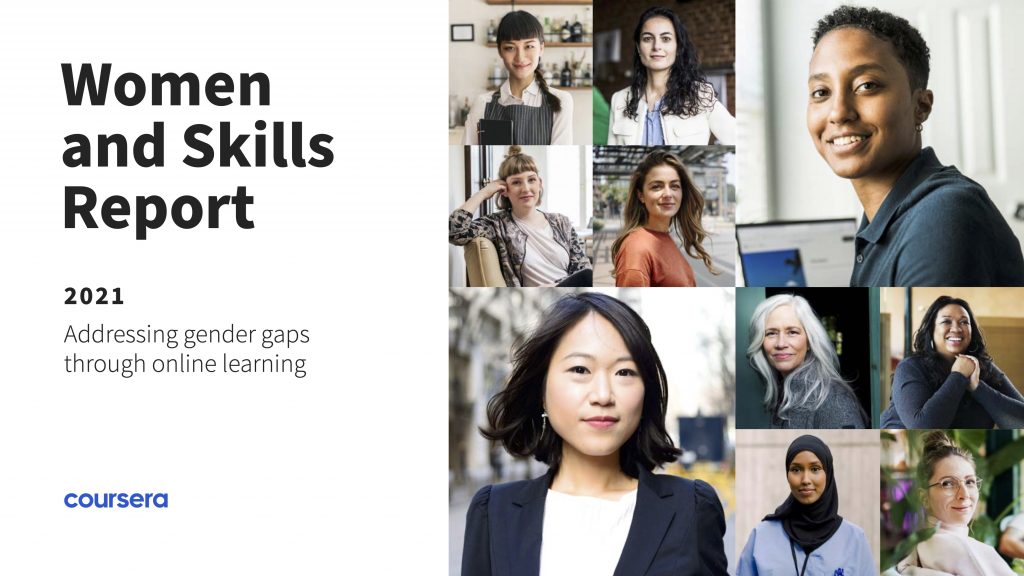
Coursera Women and Skills Report indicates a narrowing gender gap in online learning

By Jeff Maggioncalda, Coursera CEO

Today I am excited to introduce Coursera’s first-ever Women and Skills Report, which examines the pandemic’s impact on skills trends among women and how online learning is helping them prepare for the future.

The dual impact of the pandemic and automation have disproportionately impacted women — largely due to school closures and the growing burden of unpaid childcare. It has exacerbated income inequality and worsened social inequities worldwide, chief among them: women’s labor force participation. According to the International Labor Organization, the number of employed women in 2021 is projected to be 13 million fewer than in 2019, while the number of employed men is projected to be about the same. And even after some recovery in recent months, only 43.2% of the world’s working-age women will be employed in 2021, compared to 68.6% of working-age men. 

Despite the exodus of women from the labor market during the pandemic, a few promising trends are emerging. The data from the recently published Coursera Global Skills Report 2021 found that women are pursuing online education, including in STEM courses, at a higher rate than pre-pandemic. The share of overall course enrollments from women on Coursera globally increased from 38% in 2018-2019 to 45% in 2020. For STEM courses, which teach many high-demand digital skills, enrollments among women grew from 31% in 2018-2019 to 38% in 2020. 

These insights inspired us to dig deeper into global and regional trends to understand how the pandemic has shifted the gender balance and potentially created more opportunities for women to acquire skills online that can accelerate their return to work and promote economic mobility. 

The Women and Skills Report shows that the increased participation rates among women observed in 2020 have sustained in 2021. Among the key global findings: 

  • 50% of new learners are women in 2021 compared to 45% in 2019 
  • 48% of women are using mobile learning in 2021 
  • 45% of overall enrollments are from women in 2021 compared to 38% in 2019 
  • Women’s enrollment growth is a worldwide trend. However, emerging countries have seen the most dramatic year-over-year increases. For example, enrollments from women in the Philippines grew by 774%, Lebanon by 729%, and Uruguay by 565%. 
  • 37% of STEM enrollments are from women in 2021 compared to 31% in 2019 
  • 37% of entry-level Professional Certificate enrollments are from women in 2021 compared to 25% in 2019 
  • Top skills among women show a balanced investment in human and digital skills, from communication (14.4M enrollments) to machine learning (7.4M enrollments)

While education is not a panacea, the Women and Skills Report 2021 indicates that the gender gap in online learning narrowed during the pandemic even as the gender employment gap widened. As the world faces new skills imperatives, this research offers a glimpse of what an inclusive future could look like in the digital economy. I hope the data and insights offered in this report act as a catalyst for new ideas that institutions can embrace to achieve greater gender parity and build a more just world. 

To download the Women and Skills Report 2021 and explore the global and regional findings, visit our website.

University of London’s new Marketing degree: An ethical approach

The brand new University of London’s Bachelor of Science (BSc) in Marketing is designed for you, that is looking for analytical skills to advance in your marketing career, but that is also interested in ethical issues associated with over-consumption, environmental crisis and inequality. 

This degree has been created with the understanding that marketing can play an important role in mitigating some of the core societal issues we are currently facing. Throughout the programme, you will have the opportunity to examine the connections between marketing and the underlying fundamentals of politics, economics and society that determine the rules for how marketing operates. 

You will understand contemporary perspectives on marketing and its implications for firms, industries and society, and will learn to identify and develop ethical,  sustainable and pro-diversity approaches. You will examine how quantitative studies can be employed in management, for sustainable business. You will develop a critical understanding of consumer behaviour and culture and its relation to digital marketing. You will also learn the strategic and operational facets of marketing set within the context of globalisation and its implications for the marketing manager and consumerism. 

By analysing real-life problems facing actual businesses and evaluating the effectiveness and limitations of different marketing and management solutions and practices you will gain the adding value analytic skills that are highly sought in the world of marketing and advertising today.

The degree balances research and applied skills, and it’s led by Royal Holloway, University of London’s Marketing Department:

“At Royal Holloway, we pride ourselves on being at marketing’s cutting edge,” said ​ Professor Alan Bradshaw, Head of the Marketing Department. “Our dual excellence in teaching and research allows us to lead international discussions about consumer experience, online culture, and branding. This new programme will allow us to do so in very exciting ways and we can’t wait to get started.”

In this programme, you will learn through a variety of highly engaging materials and activities such as pre-recorded videos, readings, formative assessments, quizzes and live tutorials. Your learning experience will be fun, and most importantly, effective. You will also have access to career resources, advice and support, which will empower you to realise your career goals.

 “Degrees continue to be one of the most valued credentials in the job market, and we’re excited to build on the global success of the University of London’s Bachelor of Science in Computer Science by launching this new programme in a high-demand field” – added Betty Vandenbosch, Chief Content Officer at Coursera. 

Applications for the October 2021 cohort are open, and the deadline is 13th September. To learn more, please visit: https://www.coursera.org/degrees/bsc-marketing-london

« Previous Page
Next Page »
Coursera

Coursera was launched in 2012 by Andrew Ng and Daphne Koller, with a mission to provide universal access to world-class learning. It is one of the largest online learning platforms in the world, with millions of registered learners and thousands of institutional customers.

© 2025 Coursera Inc. All rights reserved.

Download on the App Store Get it on Google Play

B Corp
  • Coursera
  • About
  • What We Offer
  • Leadership
  • Careers
  • Catalog
  • Professional Certificates
  • MasterTrack™ Certificates
  • Degrees
  • For Enterprise
  • For Campus
  • For Government
  • Become a Partner
  • Coronavirus Response
  • Community
  • Learners
  • Partners
  • Developers
  • Beta Testers
  • Translators
  • Tech Blog
  • Teaching Center
  • Connect
  • Blog
  • Facebook
  • LinkedIn
  • Twitter
  • Instagram
  • More
  • Press
  • Investors
  • Terms
  • Privacy
  • Help
  • Accessibility
  • Contact
  • Articles
  • Directory
  • Affiliates