Coursera
  • Find a Course
  • Sign Up
Coursera Blog
  • Degrees
  • For Business
  • For Educators
  • Product News
  • Stories

Coursera’s University Partners are Recognized Among Forbes Top 10 List of “New Ivies”

For a second year, Forbes has recognized a top ten list of “New Ivies.” These university graduates are said to be “outpacing most Ivy Leaguers in the eyes of employers” with similarly selective admissions processes and rigorous coursework. 

Among the 10 ranked public schools, Coursera proudly partners with the University of Illinois Urbana-Champaign, the University of Michigan, and the University of Pittsburgh to host their degree programs, 100% online. In terms of the top 10 private universities, Coursera partner Georgetown University takes 3rd. 

Employer endorsement

In speaking with over 380 C-suite executives, Forbes deemed that employers might be reconsidering their prior affinity of Ivy League grads. The article notes that out of the executives surveyed, “Forty-two percent said public colleges were doing a better job at preparing entry-level job candidates than they were five years ago.” Egos, groupthink, and lack of job readiness were all cited as rationales for potentially pivoting the hiring pool away from what it might have once been. 

The growing credibility of online degrees

Expanded ways of thinking about talent acquisition don’t start and stop with which university a candidate graduated from. Non-traditional, online learning has also been increasingly accepted by employers, especially post-pandemic. 

Champlain College’s 2023 national survey of 2,000 U.S. adults reported that 84% believe employers are more accepting of online degrees today than before the pandemic and 72% of adults feel an online education is more reputable now than five years ago.

Proving this hypothesis is a 2024 survey by the National Association of Colleges and Employers (NACE) which found 87.4% of employers had hired new graduates with an online degree and 100% of those employers paid online degree hires the same starting salary as traditional graduates​. This indicates near-parity in how online credentials are being treated, namely from universities that made the “New Ivies” list. 

Online degree programs built for Coursera

The University of Illinois Urbana-Champaign, the University of Michigan, the University of Pittsburgh, and Georgetown University partner with Coursera to offer some of their rigorous and career-aligned degrees, 100% online. Though none of these institutions are traditional Ivy Leagues, these esteemed universities are producing graduates that top employers respect. By partnering with Coursera to deliver their online degrees, these universities are able to offer their students high-quality faculty-led instruction with the support of a platform that is working to upskill and reskills millions of learners across the globe. 

We applaud each of our university partners for the Forbes accolades and for continuing to innovate and lead with forward-thinking approaches to delivering their high-quality instruction, online. These opportunities have paved the way for learners around the globe to achieve a top education and turn their ambitions into real-world success.
Read the Forbes article here

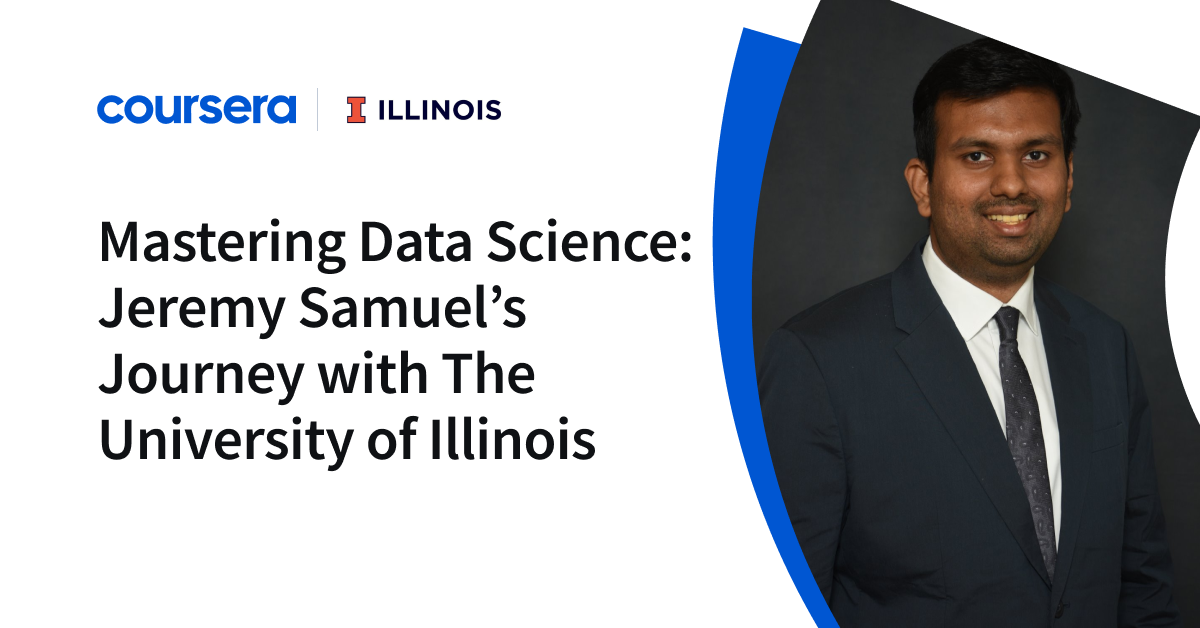
Mastering Data Science: Jeremy Samuel’s Journey with The University of Illinois

Balancing Full-Time Work and Online Learning to Stay Ahead in the Tech Industry

Jeremy Samuel’s online degree journey is a testament to his dedication and the transformative power of continuous learning. As a full-time employee at JPMorgan, Jeremy has pursued not only one, but two master’s degrees with the University of Illinois Urbana-Champaign. Most recently, he completed the Master of Computer Science in Data Science (MCS-DS) online from the Grainger College of Engineering and is now doubling down on his studies in pursuit of the  Master of Science in Technology Management (MSTM) from Gies College of Business on campus.

Deepening Technical Expertise

Identifying a need to stay up-to-date with trends and the ever-evolving tech industry, Jeremy decided the MCS-DS program was an excellent fit. He found the curriculum to be both challenging and rewarding, particularly in the areas of machine learning and AI. “The courses were extremely comprehensive and covered relevant skills that could be applied to what’s happening in the industry today,” he shared. This depth in technical knowledge not only enhanced his skills but also sparked a deeper interest in research and advanced learning.

Transitioning to Leadership

After completing the MCS-DS program, Jeremy transitioned to the MSTM program to further his career goals in technical leadership. In this second master’s degree experience , he honed skills using tools that would help him make effective data-driven decisions, a crucial skill for leadership roles in the tech industry. Recognizing the synergy between these two degrees, Jeremy notes, “I learned how to read and understand data in the MCS-DS program, and I’m learning how to use that data to make decisions in the MSTM.”. This combination of technical expertise and exposure to management has positioned him well for his next career move.

 Learning from Mumbai

During his time in the MCS-DS program, Jeremy was based in Mumbai, which threatened a set of challenges with time differences for office hours and group projects.. However, Jeremy praised the flexibility and structure of the program that offset any difficulty through recordings and an active Slack channel where he could ask questions asynchronously. He added, “The program team is great at trying to group students with similar time zones to make collaboration easier.”

Balancing Work and Studies

The online format of the MCS-DS program was a key factor in Jeremy’s decision to pursue his degree during the pandemic. “I was initially hesitant to move away from home because of the fear of Covid, and the online format allowed me to continue my education while staying safe,” he said. The flexibility of the program enabled him to balance his full-time job at JPMorgan alongside his studies during the MCS-DS. He has since left JPMorgan and shifted his focus toward his second master’s degree on campus in Champaign, Illinois. “The transition to the on-campus MSTM program was smooth due to my prior experience with the university,” Jeremy added.

Looking Forward

Jeremy is now eligible for and pursuing roles that allow him to shine using his technical expertise and managerial skillset. He aims to become a better leader in the industry and leverage both of his dynamic and complementary degrees. His educational journey from the MCS-DS to the MSTM underscores the importance of upskilling and continuous education in a rapidly changing tech landscape.

Taking the data science path to a Master of Computer Science from Illinois

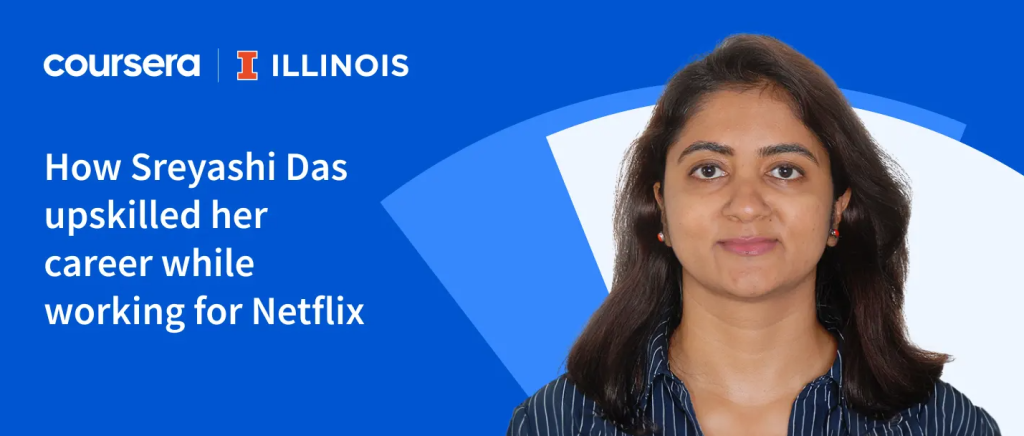
How Sreyashi Das upskilled her career while working for Netflix

Sreyashi Das is a 2022 graduate of the Master of Computer Science in Data Science from the University of Illinois Urbana-Champaign (UIUC). She’s a senior data engineer at Netflix who prepared to enhance her specialty by building her skills in this program that was recently named the #1 Best Online Master’s in Data Science Program by Fortune.

With computer science and data science flourishing, Sreyashi can look forward to a career full of potential. According to the US Bureau of Labor Statistics (BLS), computer and information technology-related occupations are expected to grow faster than average between 2022 and 2032 [1]. The BLS also estimates the mean annual salary for data scientists is $119,040 [2].

Sreyashi’s pathway is one of two available in the program, as students can pursue either the Master of Computer Science (MCS) or the Master of Computer Science in Data Science (MCS-DS). When asked why she chose the MCS-DS, Sreyashi says that she worked closely with data scientists as a data engineer at Netflix and wanted to discover the impact of their data sets. She adds, “The diverse set of courses piqued my curiosity. I had heard great things from my friends that also took the program.”

Realizing that she could complete the program around her work schedule—and recognizing it was a good value for the cost of tuition—Sreyashi decided to apply. Once she was accepted and enrolled, Data Visualization and Data Mining soon became two of her favorite courses. She especially notes how she could relate what she was learning to her real-life experiences.

Looking back now, Sreyashi tells us, “The program had good course materials, the professors were great, and the fact that it was online gave me the flexibility I needed. The online learning environment gave me as much, if not more, than what I would’ve gotten in an on-campus program.” She continues by noting, “There are resources like Slack that allowed me to connect with other students taking the same courses. I was in study groups with people across the world and it provided a global experience and exposed me to different perspectives.”

After completing the MCS-DS, Sreyashi also has full appreciation for the help she received from university staff and the impact she’s made in her career. She says, “The graduate team really supported me throughout the whole program and gave me the confidence to finish. All of the coursework was relevant, and I was able to apply what I learned directly to my job.”

Sreyashi’s story is a great reminder that when you’re seeing interesting work done by others, you can learn how it’s done and find yourself in an exciting new career. If computer science or data science has captured your imagination too, check out the MCS and MCS-DS from UIUC today and consider the possibilities for your own career.

1. US Bureau of Labor Statistics. “Occupational Outlook Handbook- Computer and Information Technology Occupations, https://www.bls.gov/ooh/computer-and-information-technology/home.htm.” Accessed June 20, 2024.

2. BLS. “Occupational Employment and Wage Statistics, https://www.bls.gov/oes/current/oes152051.htm.” Accessed June 20, 2024.

Learn more about the Master of Computer Science.

How an MCS grad chose his pathway with Illinois—a top-5 computer science school

Rahul is a recent graduate of the Master of Computer Science (MCS) program from The Grainger College of Engineering at the University of Illinois Urbana-Champaign (Illinois) on Coursera. With U.S. News and World Report naming Illinois’ Department of Computer Science in the top 5 in 2023, Rahul could confidently pick the MCS. Rahul had also earned his bachelor’s degree from The Department of Computer Science and taken machine learning courses on Coursera, so he was sure he could succeed with an Illinois program on the platform. “I knew the quality of the professors. I also knew the recognition and value of the degree in the market,” he says with conviction.

With the MCS, there are two pathways for different interests and goals. You can either select general computer science or data science as your pathway. For Rahul, the decision was clear. “I wanted to go back because the data science component was attractive,” he reveals, adding, “I wanted to catch up on all the new technologies since my undergrad.” Having been in his computer science career for approximately two decades, including tenures at both small and big companies, he also knew he wanted to gain additional experience in the ever-changing field. Ultimately, he says, “I wanted to land a job that would allow me to build on my previous work experience.”

Rahul earned his bachelor’s degree in computer science on campus at Illinois. However, when he returned for his master’s degree, he knew the online program would be the best fit for his family’s work-life balance. He notes, “The online program is not much different than being on campus. You get the interaction with instructors and peers, and the flexibility worked really well for my schedule.”

In addition to the fact that it supported his lifestyle, Rahul saw other benefits to learning on Coursera. “The tuition wasn’t as expensive, and I wanted that TA support,” he remembers, while also mentioning, “We had a Slack channel. It was a helpful resource to be able to network with other students and also get questions answered. It’s very much a collaborative program.”

Having graduated with his MCS in the spring of 2023, Rahul has now had the opportunity to reflect on his time in the program and appreciate the impact he’s made on his career by earning his master’s degree. He proudly states, “I got a job in Hollywood because of the knowledge I picked up in one of the courses. It very much qualified me for my role.” Rahul also has this advice for others who are considering the MCS: “It’s good to understand your WHY when you’re applying to the program. It’s going to be work, but it’ll also be rewarding.”

Rahul’s story shows us how you can learn on your terms with Coursera and earn a computer science degree with Illinois—whether that’s through the general computer science or data science pathway. If you’re thinking about a career in computer science, check out the Master of Computer Science from The Grainger College of Engineering at the University of Illinois Urbana-Champaign today and learn more about the two pathways you can take.

Learn more about the Master of Computer Science from the University of Illinois.

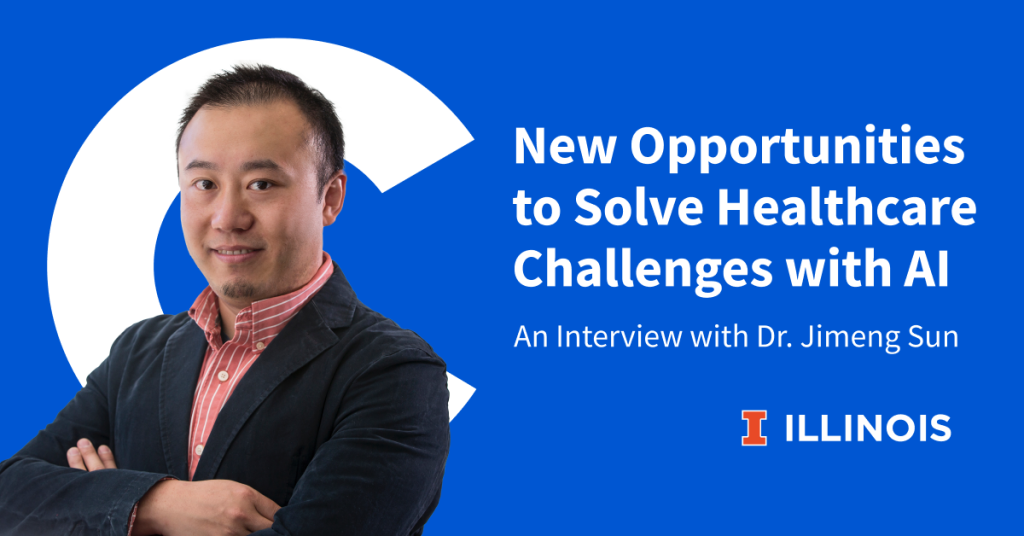
New Opportunities to Solve Healthcare Challenges with AI

An Interview with Dr. Jimeng Sun about the new Deep Learning for Healthcare Specialization on Coursera

Artificial intelligence and deep learning are being used to solve important challenges in the field of healthcare, and these innovations are being made possible through the groundbreaking efforts of visionary practitioners who work at the intersection of health and computer science. 

With the launch of the new Deep Learning for Healthcare Specialization on Coursera, anyone interested in solving real-world healthcare problems can now explore how deep learning methods can be applied to these pressing global issues.

Dr. Jimeng Sun, a professor with Illinois Computer Science and the Health Innovation Professor with the Carle Illinois College of Medicine at the University of Illinois Urbana-Champaign, leads the new Specialization. 

With his dual expertise in computer science and healthcare, Dr. Sun is a highly influential voice at the intersection of technology and healthcare. He was recently recognized as one of the Top 100 AI Leaders in Drug Discovery and Advanced Healthcare by Deep Knowledge Analytics. Through his roles as both researcher and academic, he is not only driving innovation in the field but is also helping to train new generations of talent.

We spoke with Dr. Sun recently about the new Deep Learning for Healthcare Specialization.

Professor Sun, how does your background in both industry and academia inform your interest in teaching Deep Learning for Healthcare on Coursera?

My previous work in academia was at the College of Computing at the Georgia Institute of Technology. Prior to that, I was on the industry side through my work at IBM. 

I have been teaching big data for healthcare for years, and I find that students have always been interested in knowing more about deep learning and its real-world applications. My PhD students are able to do a lot of research and publish their work on the topic of deep learning for healthcare. I think I’m ready to offer this topic to a broader student population.

What background does a learner need to succeed in the Deep Learning for Healthcare Specialization?

This is designed to be an introductory graduate-level Specialization. Students will need a strong Python programming background, but while a machine learning background is recommended, it is not essential. And, students do not need a background in healthcare. 

Previously, I have worked with students who are coming directly out of a bachelor’s program, and I have also worked with students who are CEOs of large medical record companies. This Specialization is designed for almost any learner around the world.

The goal here is to help students develop a basic understanding of deep learning and how they might apply it in their own careers. 

What excites you about teaching deep learning on Coursera?

I have been providing my courses in an online format for years, but the potential scale and quality of coursework that I can provide via Coursera are particularly exciting. In the past, I’ve had to put a cap on the number of students in my classrooms because I couldn’t find enough teacher assistants, but this Specialization will give me access to broader student populations and relieve that pressure. 

Plus, I am able to provide quality content in a condensed time frame through the online delivery of these Coursera modules, which will give both my students and myself more time to focus on our research and projects.

That’s a great segue to our next question—what are some of the key ways learners will benefit from this Specialization?

First off, the University of Illinois Urbana-Champaign has one of the leading graduate Computer Science programs in the country (most recently ranked 5th by US News and World Report in 2018). This is a large, very strong, integrated computer science program that provides ample engagement between students and professors.

Secondly, this Specialization is very method-oriented. In the past, other courses that have focused on AI and healthcare have had more of a “follow-the-problem” approach. But in this Specialization, we will be focusing on methodology. Students will first learn the deep learning method and then apply that method to a healthcare setting.

You mentioned other settings where these skills can be applied. Can you tell us more?

Because the deep learning methods I teach can be applied to any industry, students who have completed my Deep Learning for Healthcare courses have gone on to roles in finance, manufacturing, technology, and more—not just healthcare. 

As someone who is leading the way when it comes to applying these transformative technologies to pressing global challenges like those we see in healthcare, is there a message you’d like to share with learners who are interested in building their careers in this field?

I would say that while much of deep learning and the processes within it are still in their early stages, the future of this work—and its real-world impact—is boundless.

~

We are so grateful to Dr. Sun for sharing his insights, and in addition to the many benefits associated with this new program that we discussed above, we also want to highlight the fact that when you enroll in the full University of Illinois’ Master of Computer Science program, the work you complete in this Specialization can be applied towards your degree.

The University of Illinois was the first North American university to offer a full degree on the Coursera platform, and we are thrilled to expand our offerings together to include Deep Learning for Healthcare as one of our newest specializations. Learn more and register today!

Solving the “Data Explosion” Problem with University of Illinois Data Mining Pioneer Jiawei Han

Jiawei Han, a professor of computer science at the University of Illinois at Urbana-Champaign, was recently named a Michael Aiken Chair, one of the University’s highest awards. The endowed chair is the latest honor in Han’s distinguished and pioneering career, with notable accomplishments including creating core data mining algorithms and co-authoring the textbook that is considered by many to have defined the field. Professor Han is also a busy and successful teacher with a love for “train[ing] the younger generation, whether at UIUC or all over the world on Coursera.” Professor Han had three PhD students graduate in May, with one becoming a professor at Georgia Tech, one joining Google, and one joining Facebook. Students taking his classes as part of the Online Master of Computer Science in Data Science degree have an opportunity to learn from him through videos and can ask him questions directly during live office hours. 

In this conversation, Professor Han shares his perspective on the history and the future of data mining, the challenge of the “data explosion” problem, and why he thinks the University of Illinois offers set students up for long term success. 

Can you explain what you mean when you talk about a “Data Explosion” problem?

Originally, people would say they are ‘data poor’ and that they couldn’t get enough data. Now there is lots of data–the new problem is actually extracting knowledge from it.

Whether you’re a journalist, a biologist, an engineer, or in almost any other discipline, there is this ‘data explosion’ problem: you need to turn unstructured data into structured knowledge. That means spend[ing] a lot of time figuring out how to structure your unstructured data into networks, and then how to mine that data. 

For example, I have a group of students who work on how to handle biomedical literature. With biomedical literature, we can easily get 36 million papers – but to effectively use this huge corpus, you would have to ask experts to label which terms are genes, which are proteins, which are diseases.

It’s not realistic to ask humans to go through 1,000 papers and go over every sentence and label them. So, we take existing dictionaries with lists of genes, diseases, or chemicals as our starting place. Then, we take the massive unlabeled corpus and try to build a network that can find patterns and linkages automatically with a machine. Data mining can replace humans’ boring work. 

You founded the data mining group several decades ago. What led you to get into this field to start with, and what has your research group accomplished over the years?

It’s a long journey! I started with databases. In the 1980s, when I did my PhD, lots of people built database systems allowing us to index them, sort them, and search them in powerful ways. I talked to my advisor and said I want[ed] the database to have intelligence, so my PhD thesis was essentially feeding the database logic and defining rules to make the database more intelligent. 

Later, I found that if you ask humans to build the rules for the database, it is still a prohibitive burden. You have limited experts, and you have unlimited data and unlimited problems – you cannot scale up. The best way is to let data show the pattern by itself: data mining. 

I clearly remember the first international Knowledge Discovery for Data (KDD) workshop in 1989, it was just 20 to 30 people in a workshop. But I got together with some of my collaborators to write and present a paper on a method to dig rules out of data. After a few years, lots of people found this direction promising, and by 1995 they held the first international conference on KDD. To everybody’s surprise, 500 to 600 people attended!

For the second conference, they elected me to be co-chair, and I shifted the majority of my research from deductive databases to inductive databases – from “you give me rules, I will get more data” to “give me more data and I will develop rules.” I had many students joining me to work on this, and we wrote several very impactful papers and algorithms. Two of these algorithms are so influential that they are introduced in many textbooks on pattern discovery. In the Spark Machine Learning Library, they have only collected two algorithms for pattern discovery – FPGrowth and PrefixSpan – and both are from my group.

And you’re teaching this influential research in your Coursera course on pattern discovery.

Yes, in 1999, I finished the first data mining textbook (Data Mining: Concepts and Techniques), and it basically defined what data mining is. The major contribution of this book is that it defined the key issues of data mining and the key things a student needs to learn. Data mining has its own dedicated algorithms, like pattern discovery, and we also use a lot of statistics and machine learning techniques like classification and cluster analysis. 

What sets the U of I data science track apart from other universities?

Because the field and applications are so broad, we need lots of different types of experts. At UIUC, we have professors from very different backgrounds; we have people from computer science, but we also have people from library information science, and we have people from statistics. So, I think UIUC has a unique advantage just because the university has so many great departments that students wouldn’t typically have access to.

The field of data mining has changed a lot over your career – where do you see it going?

Data mining basically serves as a bridge between core techniques like machine learning, statistics, and optimization and their application to real world problems – and we are not confined to any approach, as we can use and develop different technologies for different problems. That’s the reason data mining has life, because you are facing the real world, which is so diverse.

Next Page »
Coursera

Coursera was launched in 2012 by Andrew Ng and Daphne Koller, with a mission to provide universal access to world-class learning. It is one of the largest online learning platforms in the world, with millions of registered learners and thousands of institutional customers.

© 2026 Coursera Inc. All rights reserved.

Download on the App Store Get it on Google Play

B Corp
  • Coursera
  • About
  • What We Offer
  • Leadership
  • Careers
  • Catalog
  • Professional Certificates
  • MasterTrack™ Certificates
  • Degrees
  • For Enterprise
  • For Campus
  • For Government
  • Become a Partner
  • Coronavirus Response
  • Community
  • Learners
  • Partners
  • Developers
  • Beta Testers
  • Translators
  • Tech Blog
  • Teaching Center
  • Connect
  • Blog
  • Facebook
  • LinkedIn
  • Twitter
  • Instagram
  • More
  • Press
  • Investors
  • Terms
  • Privacy
  • Help
  • Accessibility
  • Contact
  • Articles
  • Directory
  • Affiliates