Coursera
  • Find a Course
  • Sign Up
Coursera Blog
  • Degrees
  • For Business
  • For Educators
  • Product News
  • Stories

Anisa Ray: Test Prep Teacher to Software Engineer

Anisa Ray, MCIT ’22, studied rhetoric in college and then worked as a test prep teacher, getting students ready to ace their graduate school entrance exams. Today, she’s a newly minted graduate of the online Master of Computer and Information Technology (MCIT Online) from University of Pennsylvania and a software engineer at Palo Alto Networks, a multinational cybersecurity company with more than 85,000 customers around the globe.

We sat down with Anisa to learn more about her journey from teaching GMAT tips to writing code that protects businesses worldwide.

What were you doing before enrolling in MCIT Online?

After college I went into teaching test preparation for people taking admission exams for college or graduate school. It started as a temporary thing, but then it became a longer-term thing. I’m also an artist, and the test prep work was flexible enough that I had a lot of time and energy to do art.

What prompted you to pursue a career change?

I reached a point where I felt that I wasn’t growing as much as I wanted to, and the challenges were no longer new. I really liked working directly with people, but I could feel that it wasn’t the final step

for me.

So I went back to the drawing board. I’ve always been interested in learning new languages—I’ve studied Italian and Greek—and I also enjoy problem-solving. For example, I used to create time- saving tools for my students. Combining those two interests led me directly to computer science.

How did you make the transition?

I had no experience in the field at all, so I started by taking Computational Thinking for Problem Solving, Penn’s free class on Coursera. That course really sparked my interest, and I had a lot of fun. So I decided to go for it, and I applied to MCIT Online. I was so excited that I read the entire textbook for the Computer Systems Programming class before getting my admission decision!

With just one course under your belt, did you feel prepared for MCIT Online?

Yes. The program was hard but doable. The material progressed in a logical way that I could follow, especially the programming classes. Once you learn the syntax and understand the sequence to execute it, then it’s just a matter of putting it all together. It was like climbing a steep hill for two years where all you have to do is put one foot in front of the other—it’s tiring, but it’s very clear what the next step is.

What was your experience like as an MCIT Online student?

The remote aspect of the program was wonderful for me. I loved the flexibility of being able to watch

videos at my own pace. I could watch them at double speed or watch them over and over again. It fit

perfectly into my life, and I thrived on it.

Did any faculty members have a particular impact on you?

The program has really high-quality faculty overall, but Dr. Tom Farmer is particularly beloved. He’s a great communicator and his lessons are really well designed, but he also emanates kindness. And when you’re jumping into something new and intimidating, having that support means a lot. He recorded a video for us at the end of class to honor and encourage us, and I’m sure I’m not the only one who cried watching it! Overall, he really inspired me.

You were a teaching assistant for Computer Systems Programming. What was that experience like?

Being a TA was great. It reinforced the course material for me, and it deepened my skills because I was debugging other people’s code. That’s an important skill because when you start a new job, you’re mostly editing and looking at an existing code base, not doing anything from scratch.

Also, people are really appreciative of your help. That’s what I loved about being a teacher prior to joining MCIT Online, so being a TA was a way of connecting my past to my present and future. I really enjoyed helping people overcome the challenges they were facing.

What are you doing now that you’ve graduated?

I’m a software engineer at Palo Alto Networks, a cybersecurity company, where I work on cloud-delivered security. We work with organizations and governments to make sure that their people are connecting safely within the network and to the internet.

I wanted to do something that felt meaningful and to contribute to something far-reaching and hopeful, so I’m where I want to be. Our products are used by massive organizations all over the world, and the company is even helping in Ukraine. It’s cool to be a part of something so positive.

What got you interested in cybersecurity?

I’d heard a lot about hacking, and I thought it would be empowering to learn how to get a computer to bypass what it was intended to do. When you understand its vulnerabilities, you understand its true nature. So I took a cybersecurity class in the program, and that was instrumental in helping me get the job that I have.

How did MCIT Online set you up for success?

The program totally changed my life. I went from having no computer skills to being able to apply for software engineering jobs at a serious company and pass their interviews, which were really rigorous. I have this career in front of me now that wasn’t even in sight before, and it’s what I want to be doing. That’s really powerful.

—

Learn more about the online Master of Computer and Information Technology (MCIT Online) from Penn Engineering.

Penn Engineering launches new Introduction to Programming with Python and Java Specialization

Penn Engineering Online Learning has just launched a new Specialization called Introduction to Programming with Python and Java. This Specialization moves quickly; it starts out by teaching basic concepts in Python and ramps up to more complex subjects such as object-oriented programming and data structures in Java. By the time learners complete this series of four courses, they will be able to write fully-functional programs in both Python and Java, two of the most well-known and frequently used programming languages in the world today.

Introduction to Programming with Python and Java is for students and professionals who have minimal or no prior programming exposure. It’s for motivated learners who have experience with rigorous coursework, and are looking to gain a competitive edge in advancing their career. It’s for folks who are thinking about applying to the University of Pennsylvania’s popular Online Master of Computer and Information Technology degree (MCIT Online) and want to sample some of the lecture videos and content from the first course in the program. The Specialization certificate will be viewed favorably by the admissions committee so be sure to mention it in your application. If admitted, MCIT Online students can get reimbursed for the Specialization.

[Editor’s note: This policy is discontinued as of December 2021.]

Hear more about the course here.

Why should you consider taking Introduction to Programming with Python and Java? “Programming will be a transformational force in nearly every industry in the foreseeable future,” says course instructor Brandon Krakowsky, Lecturer for Penn Engineering. “With this Specialization, anyone with determination can quickly get up to speed.” Learners will encounter in-depth coding demonstrations, hands-on coding exercises and assignments with real-world applications.

The four courses in the series are:

  • Introduction to Python Programming
  • Data Analysis using Python
  • Introduction to Java and Object-Oriented Programming
  • Inheritance and Data Structures in Java

Get started today!

Current MCIT Online Students Discuss Community in Online Learning

The University of Pennsylvania’s MCIT Online degree prepares students without a computer science background to launch rewarding careers in the computing and technology industries. This 100% online program also helps students passionate about their current field — whether it’s business, music, or product management — learn how to harness the power of technology to drive innovation. MCIT Online students get the same top-quality instruction provided by the on-campus program and graduate with the exact same degree, but with the benefit of learning on their own schedule from anywhere in the world. 

Hear from current MCIT Online students as they discuss the community in online learning, the opportunities they received even before graduating, and how they balance work and studying. 

The MCIT Online program fosters a rich and inclusive community for students, granting access to core services from the University of Pennsylvania that support their well-being and future career goals. These resources, combined with a strong alumni network, prepare students from a variety of professional backgrounds to succeed in the tech industry.

MCIT Online accepts applications for the fall and spring semesters. Learn more about MCIT Online and the application process on Coursera.

When it “Clicked”: A Penn MCIT Online Student Shares How He Went From No Computer Science Background to Coding Video Games in 3 Months

Working full time for the U.S. State Department, Aleks Jarcev has mastered time management while earning his degree online.

Aleks Jarcev grew up spending endless hours playing computer games and even attempting to build them. Now, after three months in the MCIT Online program from the University of Pennsylvania, he is coding video games on his own.

As a teenager, Jarcev and his friends would bring their computers to each other’s houses, network them together and play interactive games. When it came time for college, he decided to pursue psychology. After college, he got a job working for the U.S. State Department and didn’t think that he would ever get back to his childhood love of tinkering with code. Then life took an unexpected turn: Jarcev’s job relocated him to Croatia. Once there, Jarcev reconnected with an old friend who was now working for a gaming studio as a software developer. Jarcev’s desire to design and create computer software was re-ignited.

Jarcev started poking around on ways he might study computer science. “I thought, ‘What could I do to try this out?’ So, I started looking around for some coding classes. Coursera sent me an email about the University of Pennsylvania’s online Master of Computer and Information Technology degree and I applied within days of receiving the email.”

With his background in psychology and experience conducting research in his current role, Jarcev felt comfortable with analytical thinking, but computer science was new to him. He started from the beginning, which is why a program designed for students without a computer science background such as the MCIT Online degree was a perfect fit.

The program’s flexible, online format also means that Jarcev can continue working full-time. Maximizing his time-management skills to stay on top of his MCIT Online coursework — he watches his lectures on Monday and Tuesday and works on his projects the rest of the week. The program’s community and collaboration through online forums helps Jarcev stay on track.

“Sitting down with people and actually looking at a problem and trying to see how we can fill each other’s misunderstanding is a great way to test my internal knowledge. I’m more active in this online format in terms of joining study groups and talking to TAs and being proactive about my learning than when I was on campus. I participate more in this online class format because it’s asynchronous – if I think of a question I can put it on Slack.”

Jumping into a completely new field isn’t easy, even when the program is designed to support people without a computer science background. Jarcev can remember the moment when it “clicked.” During the second assignment of his first introductory class, he had been working on a problem for more than two days and couldn’t figure it out.

“I pored over the problem again and again. But, then, it clicked. I finished the assignment that night because it was so exciting to understand it. It just flowed from there on. There are always new concepts that are added on that aren’t easy, but once you get over that initial hurdle you can really walk on your own two feet.”

Jarcev’s quick progression is the most rewarding part of the program, he said. When he started Introduction to Software Development, one of the first introductory courses, he had never written a complete line of code. By the end of the course, he had created a video game with his classmates. Soon after, he landed an internship with his dream company.

Jarcev’s advice to anyone considering the Penn MCIT Online degree is to take the leap. “If you are interested in this career, this is a viable option. It is a true commitment and a true university experience,” he said. “MCIT Online is a tight knit community. I have made friends and I have met people face-to-face. I feel like a Quaker and I think most people in the program do. The professors and TAs are all great, professional, and truly encouraging. The top-notch faculty are committed to your success, which is a great thing to experience.”

Jarcev hasn’t decided how he’ll use his degree just yet, though he is interested in joining a large technology company. As he progresses through his third semester, he is finding that the places he can go with computer science are vast. In less than two years, Jarcev went from someone who loved computer games but couldn’t write a single line of code to a capable software developer, excited about the new world that is now open to him.

The University of Pennsylvania’s MCIT Online degree is designed to take people with no computer science knowledge and prepare them to launch careers in software engineering or to innovate in their current fields.. Upon completion of the degree, on-campus MCIT alumni have gone on to earn jobs with competitive salaries at technology companies such as Amazon, Facebook, Google, Microsoft, Oracle and Bloomberg. Learn more about MCIT Online and the application process on Coursera. MCIT Online accepts applications for the fall and spring semesters.

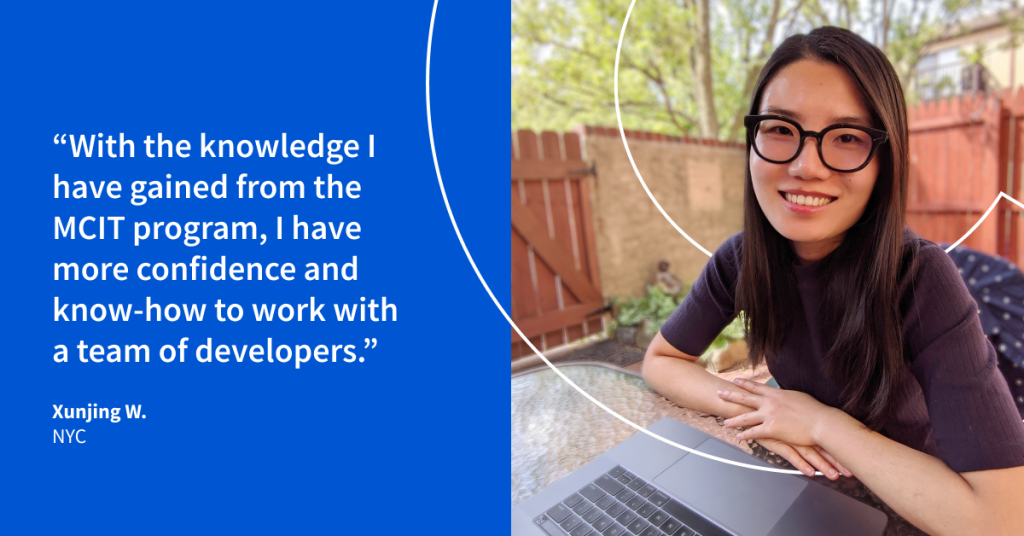
Xunjing Wu on a Mid-career Switch to Computer Science

Halfway through her first year in MCIT Online, Wu says she’s already considering applying for a product management role.

Xunjing Wu was working as a GIS analyst in a global infrastructure company in 2015 when she signed up for her very first computer science course online. With a background in urban planning, she used spatial data and GIS software regularly, but thought that the Python programming language would help her be more efficient in her role.

“Working there and at a startup afterward reinforced the idea that I needed to have the skills and the tools to understand data better,” Wu said. “As a kid, I didn’t have access to a computer, but I remember that after I started working, I knew I needed and wanted to learn programming.”

Over time, this interest in a better understanding of data transformed into a plan to pursue a career in software engineering or product management, which is when Wu started researching her options. She methodically researched bootcamps, on-campus degrees and online degrees that are open to students without a computer science undergraduate degree. When she learned of the University of Pennsylvania’s Online Master of Computer and Information Technology degree, it became her first choice, and Wu eventually became part of the program’s first cohort. “I applied to Penn and only to Penn,” she said.

This unique degree designed for students without a computer science background meant that Wu could earn an advanced computer science degree without restarting her education from the beginning. She already had an undergraduate degree in English and Literature and a Master of City and Regional Planning. Plus, with a husband and life in New York City, a quality online degree was very attractive.

Before she decided to apply, she sat down with her husband and reached out to friends who worked in the tech industry. While the University of Pennsylvania’s Ivy League status was enticing, she said the most important consideration in her decision was that so many alumni of the MCIT on-campus program had gone on to become software engineers at top companies such as Facebook, Google and Bloomberg after graduation. With only one month before the application deadline, she immediately reached out to her professors and colleagues for reference letters and started drafting her personal statement.

As a current student enrolled in the MCIT Online program, Wu spends her week balancing coursework for two courses and pitching new ideas to friends and former colleagues. With an entrepreneurial mindset, Wu said she’s passionate about working on impactful products. In her first year in the program, she expects to complete six of the ten required courses and said she is considering pursuing an entry-level programming role already, even before she graduates.

“I took online courses before, which I actually quite liked. I enjoy learning at my own pace,” she said. Having little formal training in computer science, Wu appreciated that there is a strong support community among her peers that she can lean on. One of her biggest concerns with an online program was that she would need to study alone and that she wouldn’t have help if she got stuck. However, that’s not the case: “When someone posts a question on Slack, you can expect help or an answer very quickly from other students. You still have that sense of community even when you’re doing it online,” she said. She even sets up live Zoom calls with her peers to work through challenges sometimes.

Wu said her favorite courses so far have been Mathematical Foundations of Computer Science, Introduction to Computer Systems, and Data Structures and Software Design because of the detailed and well-organized professors and course content. “I was impressed by the promise that it would be the same quality as their on-campus program: the courses are very solid.”

Wu said she plans to graduate at the end of next year and looks forward to attending the graduation ceremony on campus to share her proud moment with her family and friends, and possibly even her parents who would travel from China. “I’m going to be so proud of myself once I get this degree because it’s definitely not easy,” she said.

Her advice to students considering the degree? Time management. “Make sure you allocate time well, especially if you’re working,” she said. “It is a lot of work and the assignments can be quite time-consuming. You won’t be daunted by the work if you allocate time well — start early and follow along every week.”

*May 2021 update*

Xunjing Wu has since then successfully transitioned into a new career and she is now a Sr. Product Manager at Comcast. Prior to landing this full-time role, she also interned as a Sr. Product Manager – Technical Intern at AWS. 

“The knowledge I’m gaining from the MCIT program has given me a better technical understanding of technology as well as the confidence to grasp new technical information and knowledge. For example, I am working closely with mobile developers at my new job. I didn’t have mobile development experience before. But having a fundamental understanding of computer science made me feel more comfortable about asking my developer colleagues to help me better understand the technical side of things, or feel more comfortable looking up technical information myself. 

I am grateful for the MCIT online community. The diversity in professional and cultural backgrounds—and the willingness and openness of the students to connect and support one another—is truly amazing. Thanks to this wonderful community, I have expanded my career network, and most importantly, made good friends. For those who are looking for their next opportunities, we have a student-driven Slack channel to share internship/job opportunities in addition to the career resources the program provides. You’ll see people sharing opportunities from their companies, as a lot of the MCIT online students work full-time. People also share other opportunities they come across. Both my internship and full-time opportunities came through referrals from MCIT classmates, and they were also helpful in sharing interview tips.”

The University of Pennsylvania’s MCIT Online helps professionals in any field leverage data mining, machine learning, and other cutting-edge technologies to further their careers. Upon completion of the degree, MCIT alumni have gone on to earn jobs with competitive salaries at technology companies such as Amazon, Facebook, Google, Microsoft, Oracle and Bloomberg. Learn more about the degree and the application process on Coursera.

MCIT Online accepts applications for the fall and spring semesters.

4 Key Skills for Successful Computer Science Learning

The University of Pennsylvania’s online Master of Computing and Information Technology degree (MCIT Online) is a one-of-a-kind program designed for students without a computer science background. MCIT Online helps professionals in any field leverage data mining, machine learning, and other cutting-edge technologies to further their careers. 

Wondering how MCIT Online will fit into your life? Take this quiz from Penn to assess your ability to thrive in an accelerated online degree program.

Here are four specific skills that can help you thrive in this groundbreaking, non-traditional program:

1. Time Management 

Online degrees like MCIT are a great fit for many students because students are able to watch virtual lectures. It’s ideal for people with a part-time or full-time job, or freelancers with flexible schedules. However, you’ll need solid time management skills to take full advantage of this opportunity, since the coursework is accelerated. 

Success in MCIT Online requires setting aside time consistently every week for your coursework. You’ll also need to set deadlines and hold yourself to meeting them. If you have trouble with procrastination, you might set yourself up for unnecessary stress.

2. Readiness to Collaborate 

Jobs in today’s computer science industry are incredibly collaborative. Researchers and computer scientists work together closely in teams, and many companies have programmers work on the same code side-by-side through a practice called “pair programming.”

MCIT Online provides plenty of opportunities to practice collaboration skills through applied group projects. Avoid the temptation to be shy. To get the most out of these collaborations, you’ll need to be ready to participate in chats, online forums, and video meetups.

3. Asking for Help

MCIT Online is designed for students and professionals from non-computer science backgrounds, and most students start their programming education from scratch. Don’t be embarrassed, and be sure to ask questions if you don’t understand something. Chances are, you won’t be the only one asking your question.

Through the online format, you’ll get plenty of opportunities to have questions answered by instructors, TAs and fellow students. This is a great habit to establish for your career, too — as MCIT graduate Theresa Brenier has learned from her work at Google, asking questions is a basic skill for every programmer. 

4. Determination to Succeed… Eventually

Programming is hard! And if you’re coming from a non-science background, you might be unfamiliar with the struggles associated with coding and debugging. The good news is that you won’t be alone: every programmer needs to wrestle with tough challenges to get their code to work properly. As Penn Engineering professor Dr. Susan Davidson puts it, “It may take you a while to shift your thought process into more of a computational thought process, but you can do it. Persist, work hard, and eventually things will get easier.”

Next Page »
Coursera

Coursera was launched in 2012 by Andrew Ng and Daphne Koller, with a mission to provide universal access to world-class learning. It is one of the largest online learning platforms in the world, with millions of registered learners and thousands of institutional customers.

© 2026 Coursera Inc. All rights reserved.

Download on the App Store Get it on Google Play

B Corp
  • Coursera
  • About
  • What We Offer
  • Leadership
  • Careers
  • Catalog
  • Professional Certificates
  • MasterTrack™ Certificates
  • Degrees
  • For Enterprise
  • For Campus
  • For Government
  • Become a Partner
  • Coronavirus Response
  • Community
  • Learners
  • Partners
  • Developers
  • Beta Testers
  • Translators
  • Tech Blog
  • Teaching Center
  • Connect
  • Blog
  • Facebook
  • LinkedIn
  • Twitter
  • Instagram
  • More
  • Press
  • Investors
  • Terms
  • Privacy
  • Help
  • Accessibility
  • Contact
  • Articles
  • Directory
  • Affiliates