Coursera
  • Find a Course
  • Sign Up
Coursera Blog
  • Degrees
  • For Business
  • For Educators
  • Product News
  • Stories

5 Tips: Learn more effectively in class with Mastery Learning

May 13, 2013

Share
Share on Facebook Share
Share on TwitterTweet
Share on LinkedIn Share
Send email Mail

Editor’s Note: Want to learn a few tips on how to learn the material in your classes more effectively? Read below to learn about the principles behind Mastery Learning, written by our Course Operations MOOC Pedagogy Specialist, Relly Brandman.

What is Mastery Learning?

​
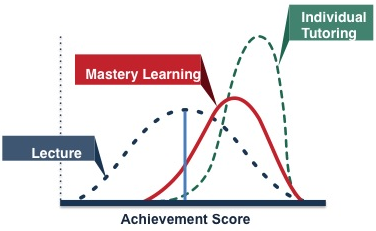
“The instruction is the same as in the conventional class (usually with the same teacher)…The average student under mastery learning was about one standard deviation above the average of the control class (the average mastery learning student was above 84% of the students in the control class).1”

In traditional classrooms, students progress through the class regardless of their level of achievement.  In mastery learning classrooms, students must fully understand (demonstrate mastery of) the material before moving on to the next topic.  Mastery learning is about how students navigate through exercises and assignments.

In a seminal study by Benjamin Bloom1, a mastery learning approach was found to improve the distribution of student scores by a full standard deviation above the control class that used the same method of instruction but didn’t require that students master the material before moving on.  
image


Figure 1: Achievement distribution for students in traditional, mastery learning, and individual tutoring instruction. Mastery learning results in one standard deviation above the average of the control class (the average mastery learning student was above 84% of the students in the control class)1.


What does mastery learning look like on Coursera classes?

On Coursera, many instructors allow students to have multiple attempts on a single quiz, allowing you to take quizzes several times until you thoroughly understand the material. Instructors have the option to use randomized quiz questions so that students see a different set of questions with each attempt. Mastery learning is characterized by both the opportunity to practice the material, as well as the benchmark for knowing when you’ve mastered the material (e.g. a high score on the quiz).

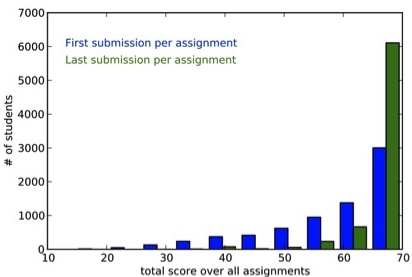
Martin Odersky (École Polytechnique Fédérale de Lausanne) allowed students to take the quizzes as many times as they wanted in his Functional Programming Principles in Scala course.  Many students kept taking the quiz until they received 100%, much like playing a game.  This, of course, led to higher scores for that particular quiz.  But students who chose to improve their scores by taking the quiz multiple times did better on their first attempts future quizzes as well.  For students of similar current performance, mastery-based score improvements correlate with future performance (Figure 2).  
image​


Figure 2: Mastery-based score improvements correlate with future performance for students of similar current performance in Martin Odersky’s (École Polytechnique Fédérale de Lausanne) Functional Programming Principles in Scala. 
​

I’m a student. How can I use this method to improve my learning?

Keep practicing each class concept until you have mastered it, before moving on to the next concept. If there are multiple attempts allowed for the quizzes and exams in your course, think carefully through each attempt and keep trying until you do really well. Look for as many opportunities as possible to practice, like extra problem sets, background reading, and discussions on the forums. Set clear benchmarks and test yourself on key concepts before moving on to the next. Below are 5 tips to get you started!

Five tips for students to start using Mastery Learning techniques today!

  1. Chose the topic/module that you want to be a master of (this will likely be found in the course syllabus).
  2. Write down explicit learning objectives. If these are provided to you by the instructor, re-write them in your own words. If they’re not provided to you by the instructor, consider discussing and honing your learning objectives with your fellow students on the dicussion forums or in your study group.
  3. Practice, practice, practice! Take and re-take the quizzes available to you, look for extra-practice problems, create practice problems with your study group, etc. Think carefully through each attempt so that you’re getting the most out of your practice.
  4. Benchmark: figure out if you’ve mastered the material by your performance on the quiz and your ability to address each of the learning objectives. Work with your study group to test each other and give each other feedback.
  5. Celebrate! Now that you’re a master of the material, you have built a solid foundation for moving on to the next topic.

We hope you enjoyed reading about this topic. Happy learning!

________
1“The 2 Sigma Problem: The Search for Methods of Group Instruction as Effective as One-to-One Tutoring.”  B. Bloom, Educational Researcher (1984).


Share
Share on Facebook Share
Share on TwitterTweet
Share on LinkedIn Share
Send email Mail

Keep reading

  • 2026’s Fastest-Growing Skills and Top Learning Trends From 2025
  • Empowering leaders to build a skills-first future
  • Celebrating 10 million GenAI enrollments on AI Appreciation Day
  • New on Coursera, Google Agile Essentials course helps professionals deliver projects and results faster
  • 2024’s Rising Content and Fastest Growing Skills for 2025
  • Wharton Online and OpenAI launch a new course on Coursera, “AI in Education: Leveraging ChatGPT for Teaching”
  • Announcing 10 entry-level Professional Certificates from our biggest partners as digital transformation reshapes the labor market
  • Google launches Prompting Essentials course as demand for AI skills continues to grow
  • Coursera celebrates AI Appreciation Day with new GenAI courses, Professional Certificate enhancements, and GenAI Academy for Teams
  • Presenting the 2024 Coursera Global Skills Report
  • Coursera launches a new suite of Academic Integrity features to help universities verify learning in an age of AI-assisted cheating
  • Announcing four new entry-level certificates and Universal Skills scholarship program from Microsoft to help learners land in-demand jobs
  • Clemson University partners with Coursera to launch first degree in South Carolina with no application*
  • Google launches AI Essentials course on Coursera to help learners boost their productivity and thrive
  • Twelve Google and IBM Professional Certificates on Coursera receive ECTS credit recommendations
  • Coursera Launches Generative AI Academy to Improve Executive and Foundational Literacy 
  • Introducing “Navigating Generative AI: A CEO Playbook” 
  • Nevada DETR and Coursera announce statewide program providing free job training to thousands of people 
  • University of Texas System and Coursera Launch the Most Comprehensive Industry Micro-Credential Program Offered by a U.S. University System
  • Coursera announces new AI content and innovations to help HR and learning leaders drive organizational agility amid relentless disruption
  • New Coursera survey shows high demand for industry micro-credentials from students and employers in tight labor market
  • Coursera and Google partner with the University of Texas System to provide critical job skills to students across eight campuses  
  • What the world learned on Coursera in 2022
  • Coursera partners with state university and workforce systems to prepare Louisiana’s workforce for jobs of the future 
  • Connecting Google certificates and university Specializations to help learners prepare for in-demand career fields
  • Coursera partners with IFC and the European Commission to publish global study on women and online learning in emerging markets 
  • Coursera Launches Clips to Accelerate Skills Development through Short Videos and Lessons
  • Preparing learners around the world for in-demand jobs with Career Academy and new entry-level certificates from Meta and IBM
  • Coursera and Milken Center for Advancing the American Dream launch free nationwide skills training initiative for underserved Americans 
  • Coursera’s response to the humanitarian crisis in Ukraine
  • Coursera announces 3 new job-relevant degrees from leading universities
  • Coursera doubles down on Middle East with new leadership, content and platform features
  • Coursera Women and Skills Report indicates a narrowing gender gap in online learning
  • Coursera accelerates India growth plans
  • Announcing the Coursera Global Skills Report 2021
  • Turning Entrepreneurial Ambition into Global Impact
  • Introducing Coursera’s Job Skills Report 2026: The most critical skills the world’s learners need this year
  • Cleveland Clinic joins Coursera to teach the latest healthcare skills at a global scale
Coursera

Coursera was launched in 2012 by Andrew Ng and Daphne Koller, with a mission to provide universal access to world-class learning. It is one of the largest online learning platforms in the world, with millions of registered learners and thousands of institutional customers.

© 2026 Coursera Inc. All rights reserved.

Download on the App Store Get it on Google Play

B Corp
  • Coursera
  • About
  • What We Offer
  • Leadership
  • Careers
  • Catalog
  • Professional Certificates
  • MasterTrack™ Certificates
  • Degrees
  • For Enterprise
  • For Campus
  • For Government
  • Become a Partner
  • Coronavirus Response
  • Community
  • Learners
  • Partners
  • Developers
  • Beta Testers
  • Translators
  • Tech Blog
  • Teaching Center
  • Connect
  • Blog
  • Facebook
  • LinkedIn
  • Twitter
  • Instagram
  • More
  • Press
  • Investors
  • Terms
  • Privacy
  • Help
  • Accessibility
  • Contact
  • Articles
  • Directory
  • Affiliates